Try Playing the Gayageum and Enjoy Horse Silhouettes ... at Gimhae's Hands-On Exhibition, 'Linking, Gaya!'
- Input
- 2026-11-25 13:37:25
- Updated
- 2026-11-25 13:37:25
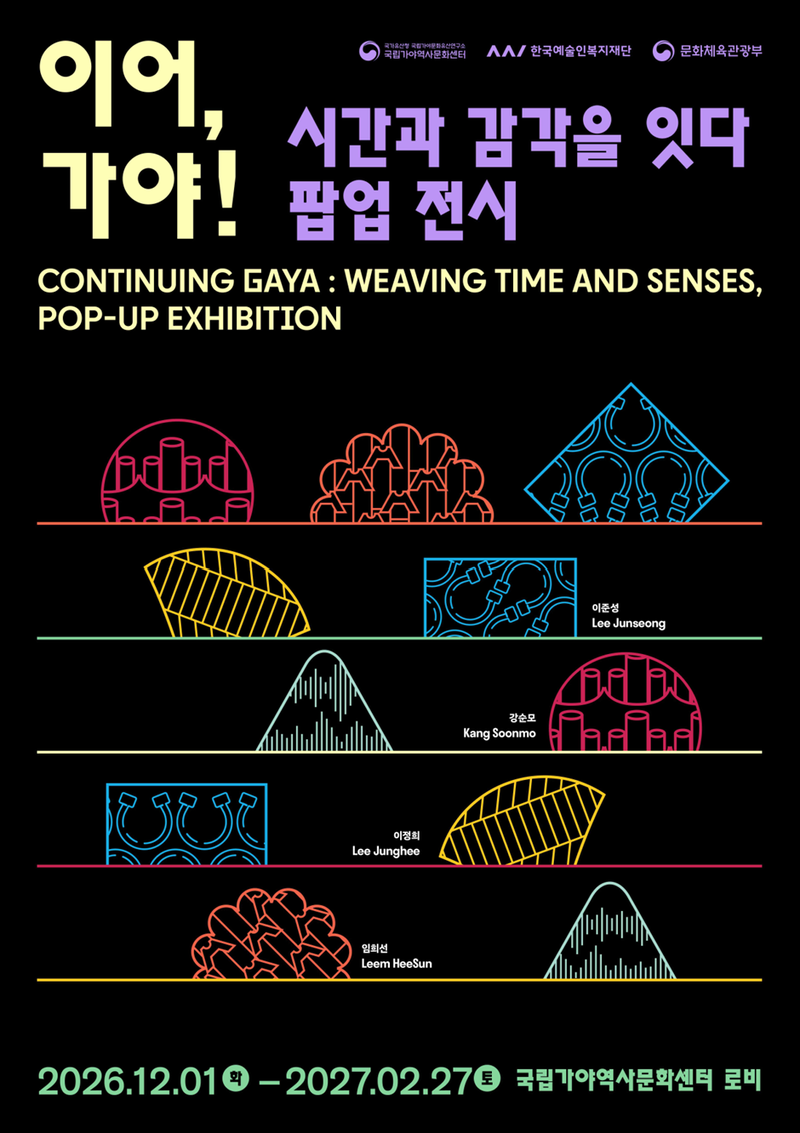
According to the National Institute of Gaya Cultural Heritage Research under the Korea Heritage Service on the 25th, the pop-up exhibition “Linking, Gaya!: Connecting Time and the Senses” will open in the lobby of the National Gaya History and Culture Center on December 1 and run through February 27 next year. The institute organized the exhibition through the Korean Artists Welfare Foundation’s “Yesullo” program, which supports collaborations between artists and companies and institutions. Four artists have interpreted Gaya’s history and artifacts through music and visual art.
Lim Hui-seon’s “Connecting the Sounds of Gaya” presents gayageum music inspired by Gaya artifacts. Visitors can try playing 12-string and 25-string gayageums, which have different numbers of strings.
The “Samguk Sagi” records that King Gasil of Gaya made the gayageum and that the musician Ureuk composed twelve pieces for the instrument. The traditional gayageum has twelve strings. The 25-string gayageum is a modified instrument with additional strings to expand its range for performing newly composed music.
Lee Jun-seong depicted Gaya’s horses as shadows in “Shadow Show.” Lee Jeong-hui’s “Reading the Soil” focuses on the perspective of an archaeologist who reads the past from traces left underground.
Kang Sun-mo recreated Gaya’s figural pottery using 3D printing in “Coordinates of Sedimentation.” Figural pottery is earthenware modeled after such forms as ducks, horses, boats and carts. The National Gimhae Museum believes that, because such pottery is often found in tombs and ritual sites, it was likely used in ceremonies praying for the peace of the dead, among other things.
The National Gaya History and Culture Center opened in September 2024 as a facility that manages research materials related to Gaya history and uses them for exhibitions and education. Its galleries introduce the “Gaya Tumuli,” inscribed on the UNESCO World Heritage List in 2023. The property comprises seven sites, including the Gimhae Daeseong-dong Tumuli. Visitors can also see a replica of the horse armor excavated in 1994 from Malisan Tomb No. 8 in Haman, South Gyeongsang Province, and a video showing how it was made.
[email protected] Jang In-seo Reporter