ChildFund Korea Discusses Integrated Support for Families in Crisis Raising Children at National Assembly
- Input
- 2026-11-25 12:58:38
- Updated
- 2026-11-25 12:58:38
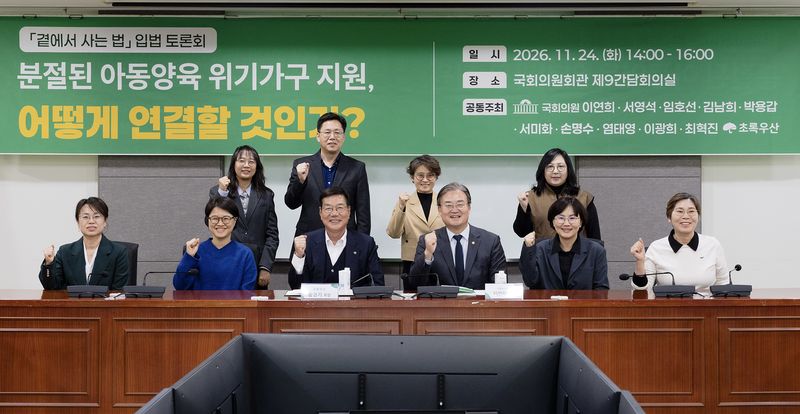
According to ChildFund Korea on the 25th, the legislative forum “How to Live by Their Side” was held on the 24th in Meeting Room 9 of the National Assembly Members’ Office Building in Yeongdeungpo District, Seoul. Nine Democratic Party of Korea (DPK) lawmakers, including Lee Yeon-hee, and independent lawmaker Choi Hyeok-jin co-hosted it with ChildFund Korea. The three amendments discussed included provisions to designate cases where child-rearing makes it difficult to make a living as grounds for emergency assistance, and to give children in households eligible for emergency welfare assistance priority access to child care services.
Families in crisis raising children are households that have difficulty caring for children because of an unexpected pregnancy or childbirth, financial hardship, housing insecurity or other circumstances. Housing support is currently handled by the Ministry of Land, Infrastructure and Transport, child care services by the Ministry of Gender Equality and Family, and livelihood assistance and integrated case management for children by the Ministry of Health and Welfare. Since last year, ChildFund Korea has called for a system to coordinate support divided among ministries according to each family’s needs.
The amendment to the Emergency Welfare Support Act, introduced by Lee last July 30, would designate cases where family caregiving or child-rearing makes it difficult to make a living as grounds for emergency assistance. It aims to reduce gaps in support caused by differences in whether local governments enact ordinances. It would also link emergency housing assistance with public rental housing and add child care services to the list of emergency assistance.
The amendment to the Child Welfare Act would include housing and care in integrated services for children from vulnerable families. The amendment to the Child Care Support Act would add children in households eligible for emergency welfare assistance to those given priority for child care services.
Song A-young, a professor in the Department of Social Welfare at Yonsei University, cited cases involving unmarried fathers and teenage parents, and said gaps in public care and housing support, along with complicated application procedures, increase the burden of raising children. Heo Minsuk, a legislative researcher at the National Assembly Research Service, said that because authority to decide eligibility for support is divided among ministries and agencies, mechanisms for coordination among them should be institutionalized.
The general discussion was moderated by Ryu Jeong-hui, head of the Research Planning and Coordination Office at the Korea Institute for Health and Social Affairs. The Korea Single Mothers Support Network, Seongbuk Housing Welfare Center, and officials from the Ministry of Health and Welfare and the Ministry of Gender Equality and Family took part and discussed ways to reduce gaps in support on the ground.
Hwang Young-ki, chair of ChildFund Korea, said, “I hope today’s discussion will lead to the National Assembly’s active consideration of legislation and close cooperation among the relevant ministries, and serve as an opportunity to establish an institutional foundation that ensures the necessary protection and support are provided from the onset of a crisis.”
[email protected] Jang In-seo Reporter