'Spot Home Hazards in Advance and Even Guide the Visually Impaired'... High School Students’ AI Is Coming
- Input
- 2026-11-25 12:00:00
- Updated
- 2026-11-25 12:00:15
[Financial News] From a housing protection service that identifies potential hazards in a home before a contract is signed to an AI alert system that tells visually impaired people about nearby objects and autonomous decision-making AI agents, technologies developed by high school students will come together at one event. The Seoul Metropolitan Office of Education (SMOE) announced on the 25th that it will hold the 2026 Seoul Student AI Development Showcase on the 27th at Peace & Park Convention in Yongsan District, Seoul. The event is intended to help students move beyond simply using existing AI and grow into developers who build AI models themselves and solve everyday problems.
Seoul education superintendent Geun-sik Chung said, “The power to think that students have cultivated in mathematics and science is now leading to the ability to build AI themselves and solve problems in our lives,” adding, “I hope this will be an opportunity for students to get advice from experts in the field and move forward as AI developers who consider technology for people.”
Rather than ranking participants in a competition, the showcase will focus on mentoring to support the teams’ growth. Six experts—university professors and AI specialists from industry—will visit each team’s exhibition booth to assess technical feasibility and practical value, among other things, and offer one-on-one advice on site.
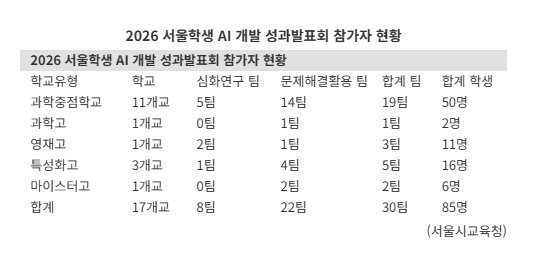
A total of 30 teams, comprising 85 students from 17 high schools across Seoul, will participate. They come from gifted schools, science high schools and science-focused schools, as well as specialized vocational and meister high schools focused on practical training. The students will demonstrate working early-stage models (MVPs) or analysis code on laptops and exchange views with experts and fellow students.
The entries span both services closely tied to everyday life and advanced algorithm research. In the “Problem-Solving Applications” category, which has the largest number of entrants at 22 teams, many practical technologies to address everyday inconveniences and help socially vulnerable groups will be presented.
Notable entries include a housing protection service that analyzes potential hazards in a home before a contract is signed based solely on its address, and an AI alert system that identifies the location and distance of nearby objects and guides visually impaired people. A customized app that analyzes youth crisis indicators alongside public education data to help students build their sense of self-efficacy will also be demonstrated on site.
The “Advanced Research” category, with eight participating teams, will showcase sophisticated technologies for which students have designed the algorithms themselves and verified their performance.
A leading example is research into AI agents that go beyond simply responding to commands to deeply analyze the intent and context of users’ questions, then make decisions and take action on their own. Other topics drawing attention in industry and academia will also be presented, including AI models that predict the properties of chemical molecules before experiments, and research validating neural network effects that aims to improve reliability by separating the process of generating an AI response from the process of verifying the evidence behind it.
SMOE plans to use the event as an opportunity to expand the foundations of AI education by linking school-based project research with club activities.
[email protected] Kim Man-gi Reporter