Black Ice Sparks Chain-Reaction Crashes and a Tunnel Fire... Government Holds Joint Drill
- Input
- 2026-11-25 17:00:00
- Updated
- 2026-11-25 17:29:08
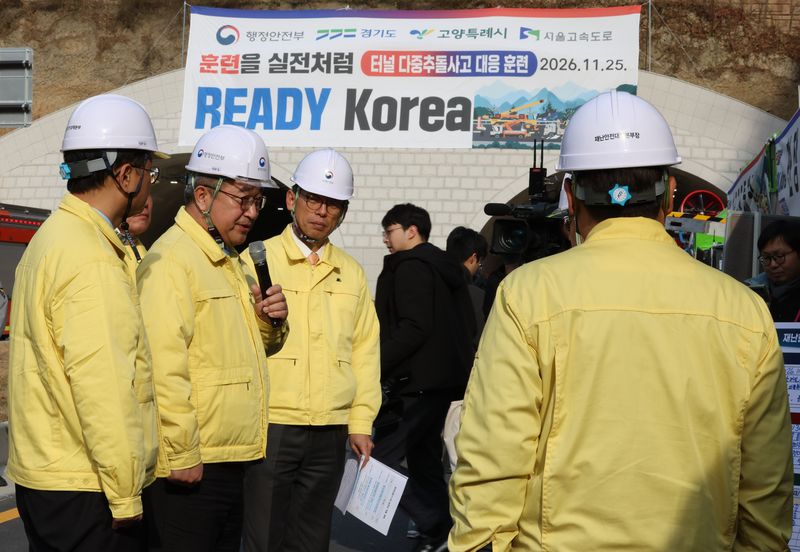
[Financial News] How should responders deal with a winter pileup in a tunnel, where black ice causes 40 vehicles to crash one after another and a fire breaks out?
The government held a joint disaster-response drill at Sapaesan Tunnel on the Seoul Metropolitan Area First Ring Expressway, simulating this kind of scenario. The exercise reviewed every stage, from evacuation and firefighting to rescue and the transport of emergency patients, in preparation for a situation in which smoke spreads quickly through an enclosed tunnel and crashed vehicles make it difficult for rescue teams to enter.
The Ministry of the Interior and Safety (MOIS) said on the 25th that it had held this year’s fourth ‘READY Korea’ drill in and around Sapaesan Tunnel in Gyeonggi Province, together with the Ministry of Land, Infrastructure and Transport, the Ministry of Health and Welfare, Gyeonggi Province, Goyang City, the National Fire Agency, the Korean National Police Agency and Seoul Expressway, among others.
READY Korea is an exercise in which public and private organizations jointly review their response systems to prepare for large-scale and complex disasters that could arise from potential risks such as the climate crisis and aging urban infrastructure.
The drill began with a scenario in which vehicles following a car that had skidded on black ice near the entrance to Sapaesan Tunnel on the Seoul Metropolitan Area First Ring Expressway crashed into it one after another. After the driver involved in the accident called 119 and the tunnel control office relayed the situation, initial response teams from the road management agency and the first fire and police units arrived at the scene.
Seoul Expressway, which manages the tunnel, blocked vehicles from entering to prevent further crashes and used electronic signs and emergency broadcasts to guide drivers and passengers to evacuate. It also operated the ventilation system to help clear smoke from the tunnel, while police controlled the tunnel entrances and exits and secured a route for emergency vehicles.
After receiving the report, MOIS held a situation-assessment meeting with the relevant agencies and decided on a response plan.
Gyeonggi Province and Goyang City each activated a regional disaster and safety countermeasures headquarters and sent emergency alerts by text message to provide information on road closures and detours. Goyang City also set up a separate integrated disaster-site support headquarters.
As fire from an accident vehicle spread to nearby vehicles and their cargo, causing multiple casualties, the response shifted to a government-wide system. The Ministry of Land, Infrastructure and Transport activated the Central Accident Response Headquarters, while MOIS activated the Central Disaster and Safety Countermeasures Headquarters (CDSCHQ), overseeing and coordinating rescue efforts, emergency medical support, and response and recovery measures.
The National Fire Agency also raised its response level and activated its emergency rescue control team. Along with extinguishing the fire, it searched for people trapped in the tunnel and rescued occupants trapped in crashed vehicles, reviewing the procedures and equipment needed to respond to tunnel accidents.
An emergency medical system was also activated in preparation for multiple patients. Goyang City’s Deogyang-gu Public Health Center set up an on-site emergency medical station and, together with Myongji Hospital’s Disaster Medical Assistance Team (DMAT), triaged patients and provided emergency treatment. The Ministry of Health and Welfare identified available beds at nearby medical facilities and arranged for seriously injured patients to be transferred to multiple facilities, while supporting patients with burns or smoke inhalation in receiving specialized treatment.
The Ministry of Land, Infrastructure and Transport and the Korea Authority of Land & Infrastructure Safety inspected structural damage to the tunnel and the risk of collapse caused by the fire. After firefighting and rescue operations were completed, Goyang City’s integrated disaster-site support headquarters led efforts to tow the crashed vehicles, remove debris, clear snow and prevent icing, and restore the facilities. Officials also considered reopening the tunnel after a detailed safety inspection confirmed it was safe.
The drill also covered procedures for supporting victims and bereaved families after the accident. These included operating temporary shelters and a disaster victim support center, providing relief supplies in coordination with volunteer organizations, arranging interpretation for foreign victims, offering psychological support, and investigating the cause of the accident.
MOIS Minister Yun Ho-jung said, “Because fires and smoke can spread quickly in the enclosed space of a tunnel, swift control of access, guidance to evacuate and cooperation among the relevant agencies are of the utmost importance. The government will prepare thoroughly for winter tunnel accidents through drills that mirror real emergencies and continue to strengthen its response capabilities to protect the lives and safety of the public.”
[email protected] Lee Bomi Reporter