Busan Commercial Real Estate Leasing Market in Prolonged Slump... “Tailored Responses Needed by Property Type and Region”
- Input
- 2026-11-25 13:39:38
- Updated
- 2026-11-25 15:15:28

[Financial News] The commercial real estate leasing market in Busan has been unable to recover from its prolonged slump. Analysts say falling rents for retail and office properties are eroding landlords’ profitability and curbing construction investment, while structural factors—including demographic changes, the spread of online shopping and declining demand for workspace—are hindering a market recovery. Accordingly, observers say that alongside short-term measures to reduce vacancies, the region needs to strengthen its underlying competitiveness over the long term by creating quality jobs and attracting consumers.
The Bank of Korea’s Busan Branch said on the 25th in a report titled “Factors Behind the Sluggish Commercial Real Estate Leasing Market in Busan and Their Implications” that the market in Busan has been relatively weak since 2018 compared with the national trend and other metropolitan cities.
According to the report, rents for medium- and large-sized retail properties have fallen 5.8% since 2018, while vacancy rates have risen from 9.0% to 15.6%. Rents for small retail properties have also fallen 7.4%, and their vacancy rate has climbed from 7.1% to 8.6%. In particular, the vacancy rate for small retail properties has risen rapidly recently, reaching a level similar to the national figure.
The office market has fared even worse over the same period. Rents have fallen 11.1%, while the vacancy rate has risen from 15.2% to 16.1%. Vacancy rates have started to decline in some areas with clusters of newly built and medium- to large-sized offices, but growing polarization with aging, smaller offices has kept that from translating into an overall market recovery.
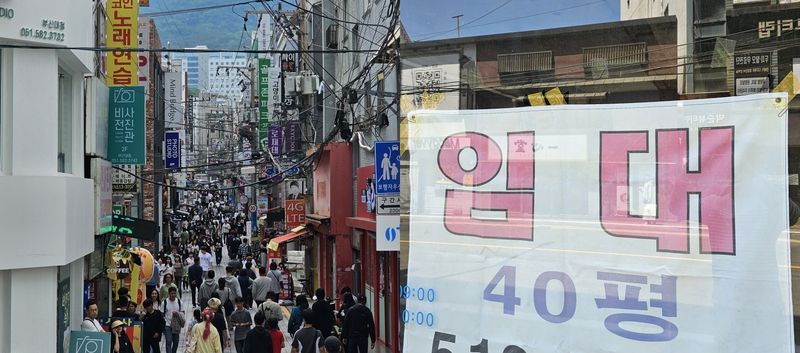
The analysis found that this prolonged slump is being driven more by a structural decline in demand than by a simple economic downturn.
The local consumer base has weakened as the population ages and one-person households grow, while the shift toward online shopping has reduced overall demand for brick-and-mortar retail space. In particular, spending has concentrated at distinctive small shops popularized through digital channels such as social networking services (SNS), which appears to have hit tenant demand for medium- and large-sized retail properties harder.
Declining demand for workspace was identified as a major cause of weakness in the office market. The share of office workers in Busan is below the national average, and the gap is widening. An earlier expansion in supply also deepened the slump in the leasing market. The report found that the increase in office construction starts from the mid-2010s put downward pressure on the leasing market after a lag of about two years.
However, the area of office construction starts has plunged since 2023 amid rising construction costs and persistently high interest rates, and additional downward pressure from new supply is expected to be limited going forward.
Lee Song-hee, a manager on the Busan Planning and Finance Team at the Bank of Korea’s Busan Branch, which prepared the report, said that short-term responses tailored to the characteristics of each property type and commercial district are needed to revive the commercial real estate leasing market.
That means flexibly allowing changes of use for medium- and large-sized retail properties and offices where structural weakness in demand makes it difficult to fill vacancies, while making better use of space—for example, by introducing locally distinctive cultural and leisure offerings into older buildings.
Lee also said it would be necessary to distinguish between thriving and struggling commercial districts, develop tailored support measures, and expand the disclosure of lease information so landlords and tenants can transparently check rental terms.
Lee stressed that, fundamentally, the region should strengthen its economic foundations by creating quality jobs and attracting consumers, thereby seeking a fundamental recovery in demand for commercial and office space.
[email protected] Kwon Byeong-seok Reporter