Barriers to Korean Wine Production to Be Lowered... Liquor Industry Gets 'Breathing Room' to Develop New Products
- Input
- 2026-11-25 10:51:55
- Updated
- 2026-11-25 10:51:55
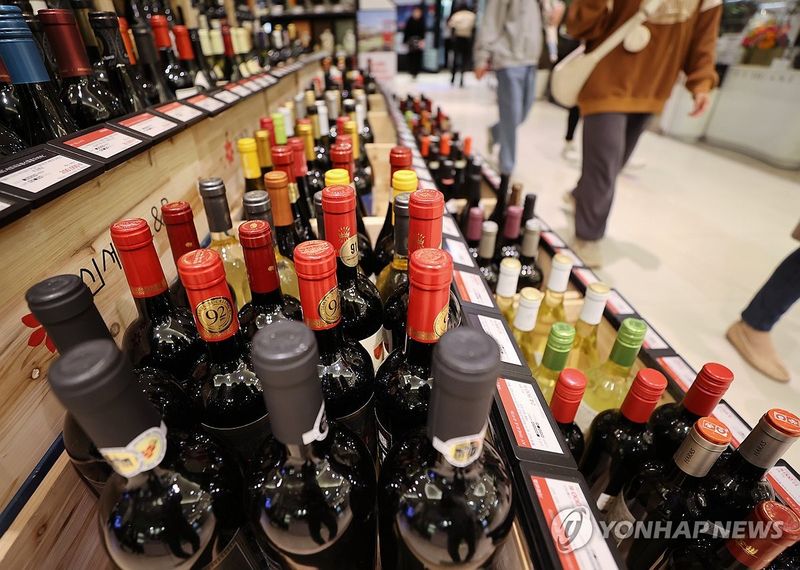
[Financial News] The expansion of the range of food additives permitted in Korean wine production is expected to lead to the development of a wider variety of alcoholic beverages.
According to relevant government agencies on the 25th, the Ministry of Food and Drug Safety and the National Tax Service have decided to ease regulations on additives in alcoholic beverages, reflecting proposals from the liquor industry. The changes will expand the range of food additives allowed in alcoholic beverages and diversify production methods.
To this end, the two agencies have been reviewing ways to improve regulations through the Public-Private Consultative Body for Improving Regulations on Alcoholic Beverage Additives, launched in June last year. The body comprises the Ministry of Food and Drug Safety, the National Tax Service, the Korea Alcohol and Liquor Industry Association, and the Korea Liquor Importers Association.
Under the proposed changes, metatartaric acid will be permitted as a stabilizer in wine (fruit wine) production to prevent tartrate precipitation. Tartrates form when tartaric acid in grapes combines with potassium, calcium, and other substances, creating sediment. The EU and other jurisdictions use metatartaric acid to prevent this, but its use has been prohibited in South Korea.
Yeast mannoprotein, which is permitted in the EU and elsewhere but banned in South Korea, will also be allowed for use to reduce wine’s astringency. Yeast mannoprotein is a glycoprotein found in yeast cell walls, made up of protein and mannose.
The government expects the regulatory changes to lead to the launch of a variety of wine products tailored to consumer preferences.
Production methods for alcoholic beverages such as beer and refined rice wine will also be diversified.
First, the permitted production methods for modified hop extract used in beer production will be expanded.
Currently, only a method that isomerizes hop extract and then further reduces it is permitted. Going forward, the authorities plan to allow isomerization without a subsequent reduction step as well, broadening the industry’s production options.
Isomerization is the process of changing the structure of the bitter compound in hops (alpha acid) to produce iso-alpha acid, the compound that gives beer its characteristic bitterness.
The authorities also decided to consider allowing the use of sodium saccharin in refined rice wine. Sodium saccharin can be used in unrefined rice wine, but its use has been prohibited in refined rice wine, despite the similarity in their production methods.
An official from the Ministry of Food and Drug Safety said, “Ongoing cooperation with the National Tax Service is necessary to support the development of a variety of alcoholic beverages,” adding, “We will continue to reflect industry views through the public-private consultative body and pursue improvements to regulations related to alcoholic beverages.”
[email protected] Kim Seo-yeon Reporter