Expanding the Net for Tracking Fugitives Abroad... PSS, Ministry of Culture, Sports and Tourism and KCS Also to Directly Access Interpol Information
- Input
- 2026-11-25 16:00:00
- Updated
- 2026-11-25 16:00:03
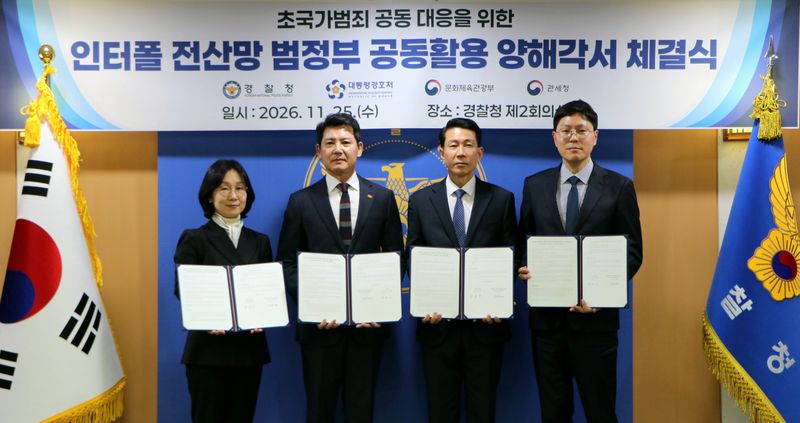
[Financial News] Starting next year, the Presidential Security Service, the Ministry of Culture, Sports and Tourism, and the Korea Customs Service will also be able to directly access Interpol wanted information without going through the Korean National Police Agency. As demand for international cooperation has grown, with the number of fugitives who have fled overseas rising to 2.6 times its 2023 level, the police have decided to share information with relevant agencies to strengthen their ability to respond to transnational crime.
The Korean National Police Agency said it had signed a memorandum of understanding (MOU) with the Presidential Security Service, the Ministry of Culture, Sports and Tourism, and the Korea Customs Service for the joint use of the Interpol network by relevant agencies at its headquarters in Seodaemun District, Seoul, on the afternoon of the 25th.
Under Interpol rules, each member country’s National Central Bureau manages access to the network. In South Korea, the Korean National Police Agency serves as the National Central Bureau and has handled requests from relevant agencies by checking whether suspects who have fled overseas are wanted and reporting back to them.
However, as criminal activity has expanded across national borders, the need for relevant agencies to make prompt use of international cooperation information in the field has also grown. The number of fugitives who have fled overseas rose from 512 in 2023 to 1,319 as of October this year.
Under the agreement, the three agencies will be able to directly access the Interpol database (DB) to the extent necessary for their respective areas of responsibility.
The Presidential Security Service will use the information in its security and protection activities. The Ministry of Culture, Sports and Tourism will use it in investigations into copyright infringement crimes, including the illegal distribution of K-Content, while the Korea Customs Service plans to use it to combat trade and foreign-exchange crimes and investigate drug smuggling.
However, requests for international cooperation, such as requests to issue Interpol notices, will continue to be handled by the Korean National Police Agency, the National Central Bureau, as before.
Security measures have also been put in place in response to the expanded sharing of information. Each agency must comply with its security and personal information protection obligations under Interpol’s Rules on the Processing of Data. The Korean National Police Agency plans to oversee each agency’s personal information protection practices, including by checking access logs every year.
Last April, the Korean National Police Agency drew up the “Basic Plan for Whole-of-Government Joint Use of the Interpol Network” and decided to gradually expand the scope of access through 2028.
This year, the Interpol database will be opened to internal police departments, and starting next year, access will be expanded to government agencies that have signed memorandums of understanding. In 2028, the agency also plans to pursue connections with the networks of international police organizations such as ASEANAPOL.
The Korean National Police Agency plans to sign memorandums of understanding with the National Intelligence Service, the Korea Heritage Service, and the Korea Coast Guard sometime next month. It will also conduct an additional survey of demand among government agencies that have not yet signed agreements.
Choi Young-jin, director of copyright policy at the Ministry of Culture, Sports and Tourism, said, “Interpol information will be a great help in tracking down copyright infringement offenders who have fled abroad, and we will actively use it to protect our content.”
Choi Moon-ki, acting director of the Korea Customs Service’s Investigation Bureau, also expressed hope that Interpol information would help with investigations and enforcement as trade and foreign-exchange crimes and drug smuggling that exploit global supply chains become more sophisticated.
Kim Dong-kwon, director of the Korean National Police Agency’s Bureau of International Police Cooperation, emphasized, “This MOU is significant because it lays the groundwork for relevant agencies to jointly confront transnational crime,” adding, “We will ensure that international cooperation information reaches the places where it is needed quickly, while rigorously upholding the principles of security and personal information protection.”
[email protected] Kim Ye-ji Reporter