“The Entire Next Leadership Is Gone”... Four Politburo Members Fall in Succession During Xi Jinping’s Third Term
- Input
- 2026-11-25 10:32:33
- Updated
- 2026-11-25 10:32:33
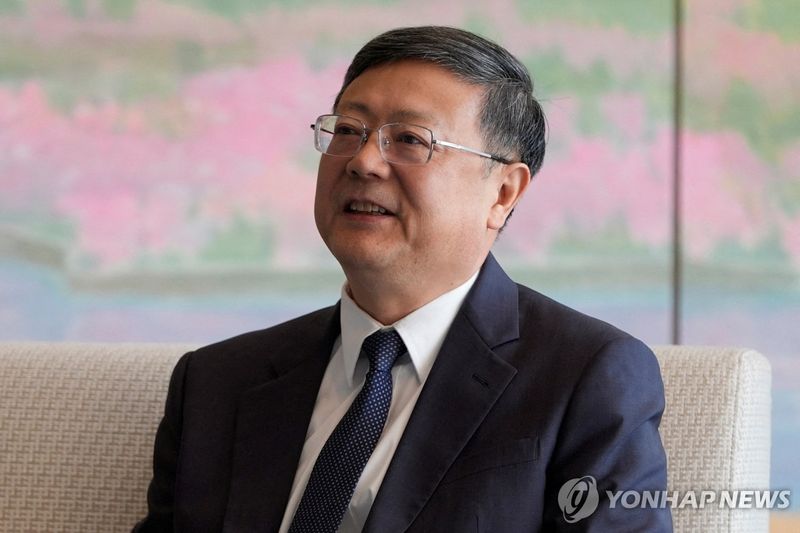
[Financial News] With next year’s 21st National Congress of the Chinese Communist Party approaching, uncertainty over the selection of the next leadership has grown as top officials have fallen one after another.
With authorities’ investigation of Chen Jining, who had been viewed as a leading candidate for the next Politburo Standing Committee, becoming public, the candidates widely seen as likely successors to President Xi Jinping have effectively all disappeared. Attention is now focused on the direction of the future reshaping of power.
Chen Jining under investigation by disciplinary authorities... major political shake-up expected
China’s state-run Xinhua News Agency reported on the 24th that Chen Jining was under investigation by disciplinary authorities on suspicion of serious violations of discipline and law. Since the party secretary, the top leader in Shanghai, heads China’s economic center and has long been seen as a key stepping stone into the top leadership, Chen Jining’s fall has drawn attention in connection with personnel arrangements for next year’s Party Congress.
This is the fourth incumbent Politburo member to fall in just over the past year, following former Central Military Commission (CMC) vice chairmen He Weidong and Zhang Youxia and Ma Xingrui, former party secretary of the Xinjiang Uygur Autonomous Region. In effect, one in six members of the Politburo of the Chinese Communist Party, formed at the 20th National Congress of the Chinese Communist Party in 2022, has been caught up in disciplinary investigations.
Singapore’s Lianhe Zaobao cited expert analysis to note that it was highly unusual for so many Politburo members to be investigated during a single term.
The successive falls of top officials selected after being vetted for political loyalty, job performance, integrity and other qualities have raised questions about the soundness of the process for selecting and managing senior cadres.
Close ties with Cai Qi, Chen Xi and others... “A signal that no one is safe”
Jean-Christophe Mittelstaedt, a China expert at the University of Zurich in Switzerland, told Reuters that Chen Jining had been a potential candidate for promotion to the Politburo Standing Committee next year, and said, “This investigation sends a signal that no one is safe.”
President Xi Jinping, former President Jiang Zemin, former Premier Zhu Rongji and current Premier Li Qiang, among others, entered the top leadership after serving as Shanghai party secretary.
The impact on the so-called “Tsinghua University network” among the Chinese Communist Party’s senior ranks is also a point of interest.
Chen Jining, a former president of Tsinghua University, worked with Chen Xi, the former head of the Chinese Communist Party’s Central Organization Department, for more than two years while at the university. Major promotions in Chen Jining’s political career also came during Chen Xi’s tenure as head of the department.
While serving as mayor of Beijing, Chen Jining worked closely for nearly five years with Cai Qi, then Beijing party secretary and now a member of the Politburo Standing Committee.
The choice of a successor as Shanghai party secretary will offer a gauge of personnel plans for next year’s Party Congress
Kou Chien-wen, an adjunct professor at the Institute of East Asian Studies at National Chengchi University in Taiwan, predicted that “the repercussions would be limited if it were a personal matter or an ordinary disciplinary violation,” but that “if it were related to political positioning, the improper granting of benefits, or cadre appointments, it could also affect the Tsinghua University network.”
Experts believe the appointment of a successor as Shanghai party secretary could offer a clue to the personnel direction at next year’s Party Congress.
Professor Kou proposed options including transferring a party secretary from a major region to Shanghai, promoting Shanghai’s mayor, or transferring an official from the central leadership or having one concurrently serve as party secretary.
Hung Yao-nan, deputy director of the Center for Cross-Strait Relations at Taiwan’s Tamkang University, cited the appointment of Chen Min’er, then party secretary of Guizhou Province, as Chongqing party secretary after Sun Zhengcai fell from his post as Chongqing party secretary in 2017. He predicted that the most likely approach would be to move a party secretary from a major region to Shanghai and then bring that person into the Politburo at the Party Congress.
Deputy Director Hung said Chen Jining’s fall meant that Politburo appointments at next year’s Party Congress would be more about filling vacancies than designing the long-term power structure, adding, “The people who fill the vacancies will be people who can be trusted, not successors.”
[email protected] Lee Seok-woo, international affairs specialist Reporter