Bae Kyung-hoon: "As AI's Autonomous Actions Spread... We Will Develop a Comprehensive Response"
- Input
- 2026-11-25 11:18:53
- Updated
- 2026-11-25 11:19:11
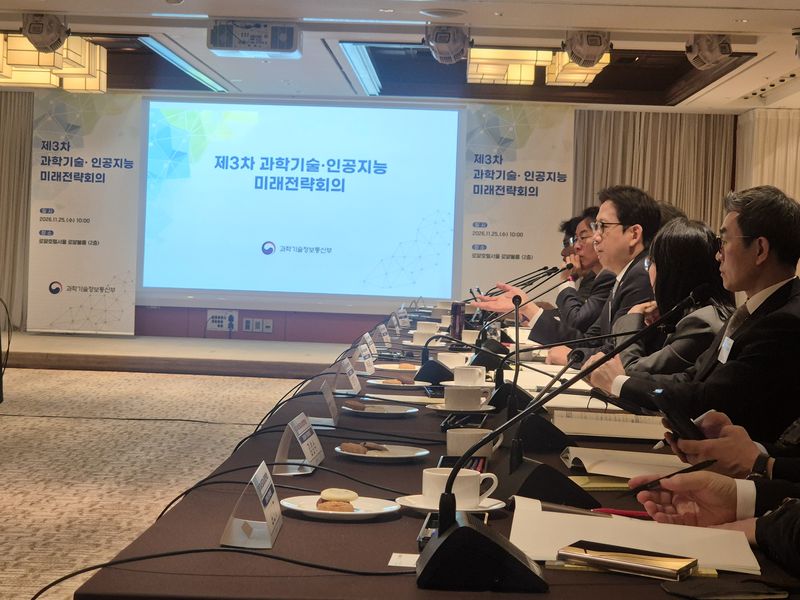
[Financial News] Deputy Prime Minister and Minister of Science and ICT Bae Kyung-hoon said, "It is important to build sufficient competitiveness in every field of artificial intelligence (AI), ensure it spreads visibly, and create reference cases," adding, "On that basis, we will develop a comprehensive response to social concerns and threats."
On the 25th, Deputy Prime Minister Bae held the third Science and Technology and Artificial Intelligence Future Strategy Meeting at the Royal Hotel Seoul in Jung District, Seoul. He said, "Each industry sector can focus, as it does now, on how to achieve results with AI," and added, "With 60% of the world's 2,000 largest companies expected to operate most of their business processes using an AI-first approach by 2029, national competitiveness will depend not only on the level of AI intelligence but also on how safely autonomous judgment and action can be translated into economic value."
He added, "Based on the opinions discussed today, we will work to proactively respond to changes across industry and society resulting from AI autonomy, continually identify mid- to long-term tasks spanning technological innovation, stronger industrial competitiveness, and social trust, and reflect them in policy."
The Future Strategy Meeting is a forum for identifying key agendas that the country must prepare for and exploring policy directions in order to proactively address changes in future society brought about by advances in science and technology and artificial intelligence (AI). The third meeting was held under the theme "The Age of AI Autonomy: A New Order for Future Industry and Society."
Deputy Prime Minister Bae said, "Looking at the current Proprietary AI Foundation Model, I expect we can produce models at least on par with those in China today," adding, "We need to make the most of the resources available to us in terms of basic AI and industrial competitiveness and build a framework for competitiveness."
He also said, "I hope to accelerate innovation in every field, including biotechnology, finance, and science, so that AI innovations spread widely and visibly, not only within companies," adding, "I expect this system for spreading AI across all businesses to be completed within one to two years at the earliest, and within two to three years at the latest."
At the meeting, participants shared the outlook that as AI develops beyond simple analysis and work assistance to plan, make decisions, and act on its own, broad changes are expected in everything from how companies and industrial sites operate to everyday life.
HD Hyundai Chief AI Officer (CAIO) Kim Young-ok presented on "The Future of Manufacturing Transformed by Autonomous Operations." She noted that the measure of manufacturing competitiveness would shift from the scale of facilities to the ability to convert on-site knowledge and experience into AI, and said, "In the AI era, people's role will change from operators to conductors."
Kim, the CAIO, proposed, "To become a leading country in manufacturing AI, we need to establish a national foundation that includes building industrial data, developing AI models tailored to each industry, and creating environments for on-site demonstration."
Next, Professor Yoon Hye-sun of Hanyang University School of Law presented on "What It Takes for a Country to Use AI Well: Legal and Institutional Strategies in the Age of AI That Acts." She stressed, "AI no longer just gives answers; it acts. The countries that use AI well are the ones that succeed." In this regard, she proposed, "We need to keep optimizing AI regulations and create a coherent regulatory ecosystem in which AI regulations are organically linked with existing regulations," adding, "We must secure institutional competitiveness that supports the safe use of AI through new institutional designs, such as a licensing system for research and development personnel and AI liability insurance."
Professor Yoon said, "I think AI is now expanding from technological competitiveness to institutional competitiveness. We need to build good institutions so that we can use technology well."
[email protected] Yeon Ji-an Reporter