South Korea’s App Market Skews Toward Google and Apple... 70% of Developers Say Fees Are a Major Burden
- Input
- 2026-11-25 13:30:00
- Updated
- 2026-11-25 13:30:03
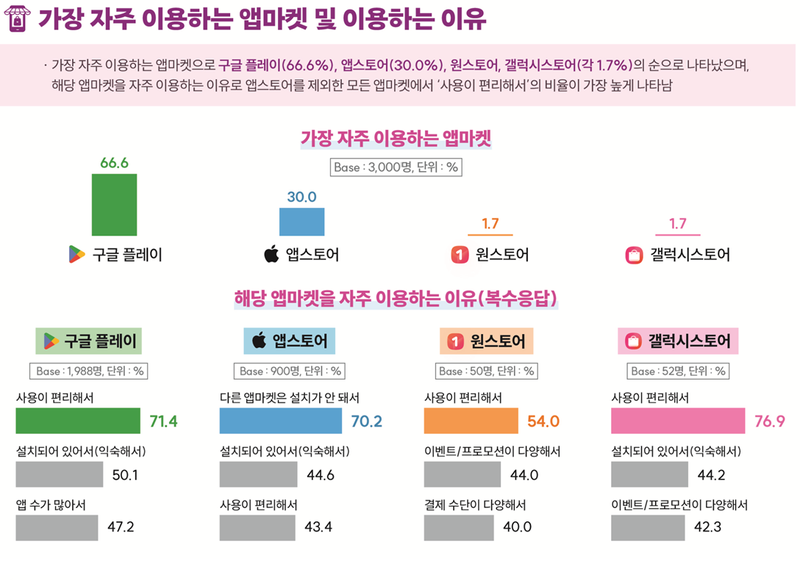
The Broadcast Media and Communications Commission and the Korea Internet & Security Agency (KISA) announced the results of the “2025 App Market Survey,” which included these findings, on the 25th.
Google and Apple account for 92% of revenue; developers face fee burdens
Last year, domestic app market transactions totaled 10.5925 trillion won, up about 9% from 9.6822 trillion won the previous year.By operator, revenue at Apple’s App Store rose about 15% year on year, while Google Play and Samsung Electronics Co., Ltd.’s Galaxy Store also grew by about 10% and 5%, respectively. ONE store, by contrast, fell about 12%.
Google Play had the largest share of app developers’ revenue by app market, at 65.3%. It was followed by the App Store (26.5%), ONE store (5.1%) and Galaxy Store (3.1%). Google and Apple together accounted for 91.8% of revenue.
Fees amounted to about 14% to 27% of transaction volume, depending on the app market. App registration fees also rose year on year by about 29% for Google Play and about 10% for the App Store.
Fees were the biggest problem developers experienced with in-app payments. A total of 68.4% of respondents pointed to fee-related issues, including higher content and service prices and user attrition due to fee burdens (35.5%) and excessive fees (32.9%).
For an app’s initial submission, the actual review took an average of 4.26 days, 1.59 days longer than the 2.67 days developers expected. For app update submissions, the actual review also took longer than expected: an average of 3.51 days, compared with an expected 2.46 days, a difference of 1.05 days.
The share of developers who had experienced app review delays was highest for the App Store (44.0%), followed by Google Play (30.8%), Galaxy Store (28.2%) and ONE store (27.1%). App registration rejection rates were also higher for the App Store (17.7%) and Google Play (15.5%) than for ONE store (12.5%) and Galaxy Store (11.2%).
Regarding app market terms and conditions, many respondents said they had experienced unfair disadvantages related to the setting of payment fees or revenue-sharing methods (45.8%), as well as app review guidelines and publishing policies (39.7%).
70% of users prefer in-app payments; refunds and cancellations are inconvenient
The average monthly spending on recurring payments (subscriptions) was 15,185 won, while the average for one-time payments was 11,337 won.Users who preferred in-app payments accounted for 69.8%, more than twice the 30.2% who preferred paying on websites. The main reason for preferring in-app payments was convenience (83.8%), while the most commonly cited reason for preferring website payments was their relatively lower cost (71.0%).
Among users who had purchased paid content, 28.1% had requested a refund. The difficulties they cited included a complicated application process (59.4%) and the time it took to receive a refund (55.9%). During subscription cancellations, the most common complaint was difficulty finding the cancellation button or menu, cited by 46.7%.
Overall satisfaction with app markets was highest for Google Play (77.7%), followed by the App Store (69.7%), Galaxy Store (67.0%) and ONE store (60.3%).
The survey was conducted from September last year through August this year among four domestic app market operators, 1,500 app development companies and 3,000 members of the general public who had experience purchasing paid content or apps.
Based on the survey findings, the Broadcast Media and Communications Commission plans to identify and address cases of unfair treatment experienced by app developers and users, and to establish policy directions for creating a fair app market ecosystem.
[email protected] Yoon Hong-jip Reporter