Towed a 180-Tonne Aircraft on Two Wheels... BYD Denza Sets a World First
- Input
- 2026-11-25 09:41:17
- Updated
- 2026-11-25 09:41:17
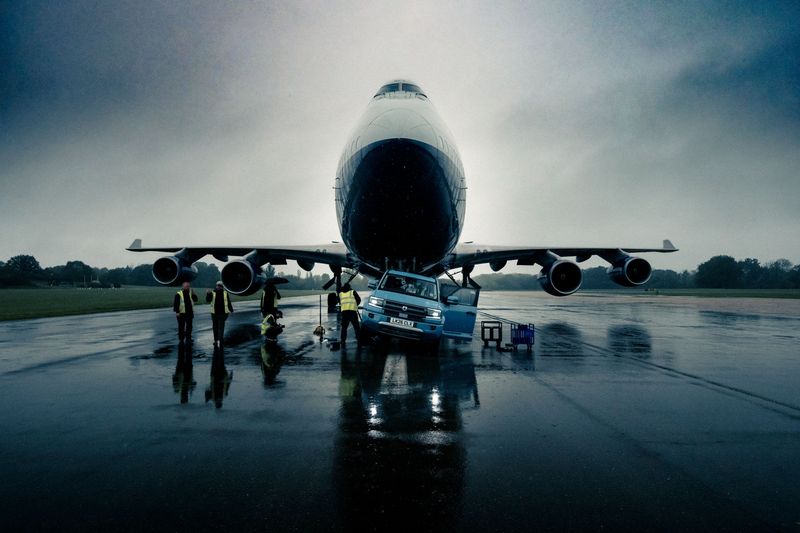
[Financial News] Denza, the premium automotive brand of Chinese electric vehicle maker BYD, has successfully towed a large aircraft weighing 180 tonnes using only two wheels of an SUV. It is the first time in the world that a production-based vehicle has towed an aircraft on just two wheels. BYD used the feat to showcase its plug-in hybrid (PHEV) technology specialized for off-road driving.
BYD said on the 25th that its off-road SUV, the ‘B5,’ had successfully completed a towing test with a Boeing 747-400 at Dunsfold Aerodrome in Surrey, England, UK.
The aircraft used in the test was a Boeing 747-400 that ended service in 2020. With its engines and cabin interior left intact, it weighed around 180 tonnes.
The towing test was conducted in three stages: four-wheel, three-wheel, and two-wheel driving. At each stage, wheels were removed from the vehicle to assess its towing performance and driving stability. Across the three runs, the B5 towed the aircraft a total of 1,600 meters, equivalent to four laps of a standard track. BYD said this was also the first time in the world that a Boeing 747 had been moved using only electric power.
The test used the ‘Ultimate,’ the top trim of the B5’s production model. It was fitted with a dedicated device for connecting to the aircraft and a small stabilizer to keep the vehicle balanced. To improve traction, the seats behind the second row were removed and ballast was added. The ballast weighed 2 tonnes for the three-wheel run and 4.5 tonnes for the two-wheel run.
The DMO plug-in hybrid system, designed specifically for off-road use and serving as the vehicle’s core power source, retained its original production specifications without any modifications. The system combines two electric motors that separately drive the front and rear wheels, one motor for generating electricity, and a 1.5-liter turbocharged gasoline engine. It delivers a combined maximum output of 544 horsepower and peak torque of 77.5 kgf·m. The vehicle can travel up to 90 km in all-electric mode, or up to 864 km with both the fuel tank and battery full.
Heavy rain on the day of the test left the runway wet and made it difficult to maintain traction. The aircraft was successfully towed once the surface had dried sufficiently. Inspections conducted immediately after each run found no signs of damage to major components, including the powertrain, chassis, and tires.
Meanwhile, BYD is strengthening its technological competitiveness through large-scale research and development (R&D) investment. Its R&D spending last year totaled 63.4 billion yuan, bringing cumulative investment to more than 240 billion yuan. The company currently has more than 120,000 R&D personnel, and its cumulative number of patent applications worldwide stood at more than 71,000 as of the end of last year.
[email protected] Kim Dong-ho Reporter