“Global AIDC Supply at 30% of Demand... A New Opportunity for Korea”
- Input
- 2026-11-25 10:09:04
- Updated
- 2026-11-25 10:09:04
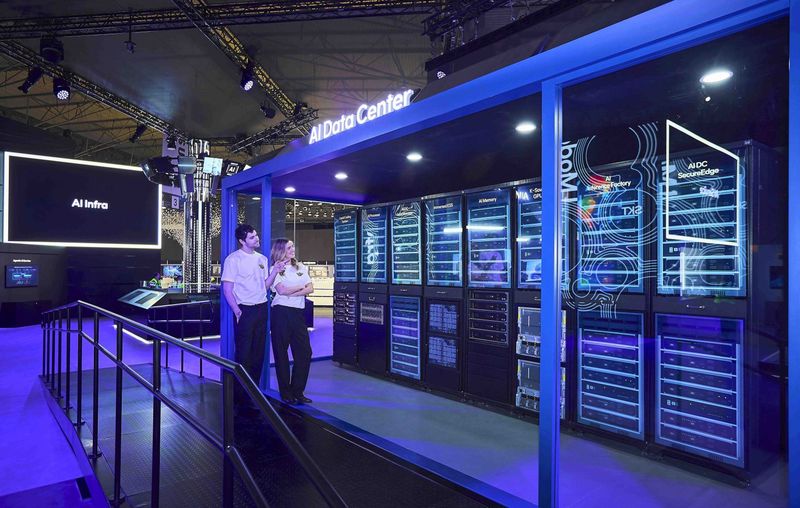
“Supply that can be secured in the short term is insufficient to meet surging demand, making it increasingly likely that U.S. big tech companies will expand their AI infrastructure hubs beyond the United States,” said Song Yeong-ung of the SKT AI Policy Research Institute. Song analyzed that this could present a new growth opportunity for Korea.
AI computing demand surges ... infrastructure supply falls short
Song said on the 25th through the SK Telecom Newsroom that “Korea has solid capabilities and expertise needed to build AIDCs, including in memory semiconductors, data center construction, ultra-high-voltage power equipment and high-speed communications networks.”According to the Tokens Per Day index, which tracks global AI usage, global token consumption is estimated at an average of about 450 trillion tokens per day as of this month. That is about 200 times the figure of 2.2 trillion tokens in January 2024.
Song cited the spread of multimodal AI and AI agents, as well as the shift in computing demand from training to inference, as reasons for the sharp rise in demand for AI computing. He explained that AI is being used for a broader range of applications beyond text, including images and video, and that AI agents are driving up computing demand by repeatedly performing inference and making data calls several times to complete a single task.
Data center supply, meanwhile, is failing to keep pace with rising demand. McKinsey projected that about 25 GW of new AI data centers would need to be built each year to meet global data center capacity demand by 2030.
Of the 85.4 GW in global AI data center development plans for 2026–2028 tallied by Clusterbid, a media outlet specializing in AI infrastructure analysis, only 24.2 GW is confirmed capacity, with power secured and permits and other requirements completed. That amounts to about 8.1 GW per year, less than one-third of the capacity additions needed.
“Even setting aside GPUs and financing, enormous amounts of time are required for transmission grids and power connections, the construction of large-scale cooling and telecommunications facilities, and environmental and local-government permitting,” Song explained. “These supply bottlenecks will be difficult to resolve in the short term.”
Big tech expands overseas hubs ... opportunity for Korea
Song noted that global big tech companies are expanding their leasing of external infrastructure because of power grid and permitting issues in the United States.He explained that overseas demand is also growing for colocation, in which local operators secure land and power, build data centers and lease them.
“If domestic companies such as SK Telecom build large-scale AIDCs and establish themselves as infrastructure hubs that reliably support global companies’ demand in Asia, the country could secure a new growth engine,” he emphasized.
He said that expanding AIDCs could also contribute to the growth of related domestic industries, including high-bandwidth memory (HBM), power equipment and cooling systems. He also cited securing computing resources for domestic AI startups, validating homegrown AI semiconductors and revitalizing economies outside the Seoul metropolitan area as expected benefits.
Song also stressed the need for public-private cooperation to expand AIDCs. The private sector should reduce construction time and energy use through efficient design and construction, as well as cooling technologies, while the government and local governments should support grid connections and permitting procedures.
“AIDC is not simply private real estate or IT equipment, but digital territory that protects technological sovereignty and data, as well as core strategic infrastructure that reshapes the nation’s industrial landscape,” he said. He emphasized that “expanding AIDC goes beyond the performance of individual companies’ new business ventures and is directly linked to the future competitiveness of the country as a whole.”
[email protected] Yoon Hong-jip Reporter