Jensen Huang's Return Boost Lasts Just One Day...KOSPI Plunges 5% Again [fn Morning Market]
- Input
- 2026-11-25 09:25:05
- Updated
- 2026-11-25 09:25:05
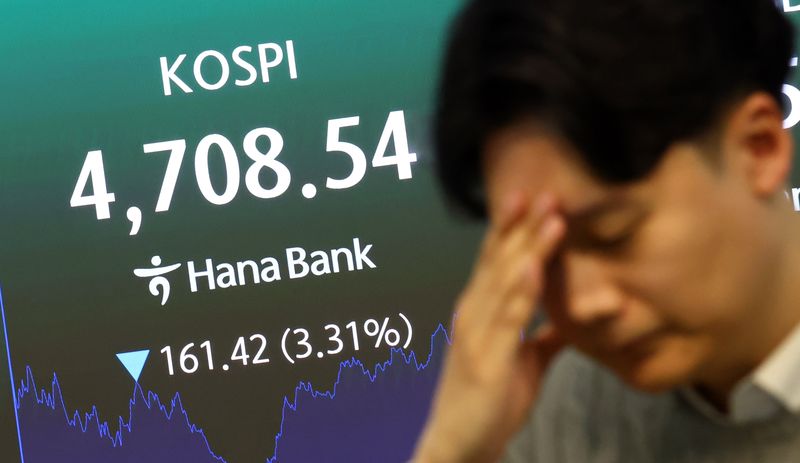
[Financial News] South Korea's stock market, which had rebounded sharply the previous day, plunged again just a day later. The KOSPI surged more than 6% on news of NVIDIA CEO Jensen Huang's return, but the upward momentum lasted only a day.
AI-related stocks in the United States plunged again, and as doubts spread over the profitability of data center investments, selling orders flooded into the South Korean market from the opening. A buy-sidecar was triggered the previous day, and a sell-sidecar was triggered today as well, prolonging extreme volatility.
According to the Korea Exchange, as of 9:17 a.m. on the 25th, the KOSPI stood at 4,757.78, down 248.25 points (4.96%) from the previous trading day. Losses approached 5% from early in the session, breaking below the 4,800 level.
The KOSDAQ was also down 3.58% at 643.21, a stark reversal from the previous day, when the KOSPI and KOSDAQ surged 6.32% and 4.79%, respectively, to stage a rebound.
The market's largest stocks by market capitalization also tumbled like autumn leaves.
Samsung Electronics was down 7.29% at 175,600 won, while SK hynix fell 6.91% to 1,078,000 won. Major semiconductor and battery stocks also slid sharply, including Samsung Electronics preferred shares (-7.79%), SK Square (-8.11%), LG Energy Solution (-8.55%) and Samsung SDI (-8.30%).
Most major large-cap stocks were weaker, with a few exceptions such as Hyundai Motor Company (-2.36%), Kia Corporation (-0.31%) and Samsung Biologics (-1.01%). Hanwha Aerospace rose 0.64%, faring relatively well.
Foreign investors' selling also picked up again. As of 9:20 a.m., foreign investors had net sold about 414.7 billion won on the Korea Exchange's main board. Individual investors absorbed the shares on offer, net buying about 441.5 billion won, but institutions also net sold about 52.2 billion won and failed to stem the index's decline.
This was in stark contrast to the previous day, when foreign investors returned to net buying and helped drive a rebound in major sectors, including semiconductors and IT hardware.
The renewed anxiety over AI originating in the United States was a major factor. On the 24th (local time), the Nasdaq index fell 1.5% on the New York stock market, while the PHLX Semiconductor Sector Index (SOX) plunged 7.9%.
Hewlett Packard Enterprise (HPE) fell 16.3% on weak earnings, bringing renewed attention to concerns over whether AI infrastructure investments can translate into actual profits.
The deterioration in hyperscalers' free cash flow (FCF), data center regulations and the possibility of a memory supply glut after 2028 are also weighing on investor sentiment.
Han Ji-young, a researcher at KIWOOM Securities Co., Ltd., said in an analysis, "Rather than interpreting yesterday's surge as a decisive signal of a trend reversal, it would be appropriate to view it as an early stage in which the excessive pessimism of the past two months is beginning to recede." The explanation was that Jensen Huang's return had eased management uncertainty at NVIDIA, but had not resolved the fundamental concerns surrounding the AI industry.
KIWOOM Securities Co., Ltd. nevertheless left open the possibility of intraday bargain-hunting, given that the South Korean market had entered oversold territory. Researcher Han said, "There would be little benefit in responding with mechanical selling," and drew attention to the possibility that efforts to find a bottom would continue as the market digested key events, including U.S. October Personal Consumption Expenditures (PCE) inflation and Black Friday spending results this week, and South Korea's November exports next week.
[email protected] Kang Jung-mo Reporter