“Mukbang and Food Ads Affect My Eating Habits”... The “Sweet Taste Effect” of Mukbang [Health Talk]
- Input
- 2026-11-25 08:53:54
- Updated
- 2026-11-25 08:53:54

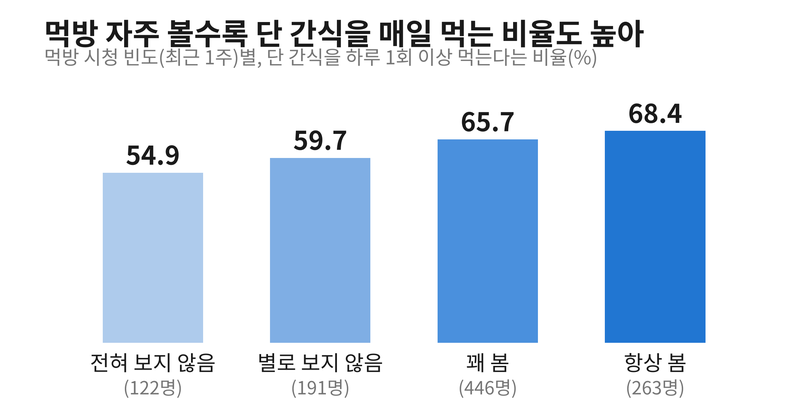
[Financial News] A survey found that the more often people watched mukbang, the more often they ate sweet snacks. Among those who never watched mukbang, 54.9% ate sweet snacks at least once a day, compared with 68.4% of regular viewers.
The SNU Center for Health Culture announced the results of a survey it commissioned Korea Research to conduct among 1,022 adults nationwide on media exposure and perceptions of health policies. Sweet-snack consumption stood at 59.7% among those who watched mukbang “not much” and 65.7% among those who watched it “quite a bit,” with the rate rising as viewing frequency increased.
The center selected four types of media content that could affect health habits—food ads, mukbang, alcohol ads and smoking scenes—and asked how much each affected people’s habits. The content respondents had encountered frequently over the previous week was most often food ads (79.9%) and mukbang (69.4%), followed by alcohol ads (52.1%) and smoking scenes (33.6%).
Respondents also felt the effects of mukbang. Mukbang was the content most often cited as affecting their health habits (71.4%), followed by food ads (68.9%), alcohol ads (47.7%) and smoking scenes (43.1%). A total of 78.3% said that either mukbang or food ads affected them—about eight in 10 adults.
Mukbang regulation: those in their 20s and 30s are “not sure,” while those 40 and older are “in favor”
Opinions on regulation were divided. More than 70% supported regulating smoking scenes (78.1%) and alcohol ads (72.0%), while views were split about evenly on mukbang and other food and restaurant shows (53.0%) and food ads (49.6%).
The generational gap was large. Support for regulating mukbang was only 30.4% among people in their 20s and 33.5% among those in their 30s, compared with 62.0% among those 40 and older. Younger people were more opposed to media regulation overall. By contrast, differences by income were small. Support for regulating all four types of media was similar across the three monthly household income brackets: under 3 million won, 3 million to under 6 million won, and 6 million won or more. In a 2018 survey, support for regulating smoking scenes rose with income, but even that gap had disappeared in this survey.
Support for regulation was little changed from eight years ago. In a 2018 survey by a research team led by Yoon Young-ho, a professor in the Department of Family Medicine at Seoul National University Hospital (SNUH), 51.9% supported regulating mukbang and 44.1% supported regulating food ads. In the current survey, support for regulating mukbang was nearly unchanged at 53.0%, while support for regulating food ads edged up to 49.6% but remained around half.
Support for health policies rises as people feel media’s influence more strongly
People who felt more strongly that media affected their eating habits also tended to be more supportive of health-promoting policies.
Overall, 71.9% of respondents supported a “sugar tax” on drinks and other products high in sugar. Support was 75.9% among those who said mukbang and food ads affected their health habits, 18.2 percentage points higher than among those who said they did not (57.7%).
The center also proposed a “Clean Health Label” in this survey. The scheme would award a certification mark to restaurants, cafes, convenience stores and bakeries that sell menu items with reduced sugar and sodium. Some 63.6% of respondents supported it, with support 68.3% among those who felt media’s influence, compared with 46.8% among those who did not—a difference of 21.5 percentage points.
By contrast, support for the sugar tax barely differed according to how often respondents watched food ads (72.0% and 71.7%). Support for the two policies also varied little by income. In other words, whether people themselves felt media’s influence was more closely linked to policy support than either income or viewing frequency.
Dr. Choi Go-eun of the center said, “The significance of this survey is that it showed that when consumers recognize the influence of mukbang and ads, which have already become part of their eating habits, their support for and sensitivity to health policies increase.”
Professor Yoon said, “It is worth considering introducing warning statements or labels so consumers can easily and quickly learn about the harmful effects of mukbang and food ads,” and proposed introducing the Clean Health Label certification for places that sell healthy menu items.
Research overseas has also examined the effectiveness of food labels. A large-scale U.S. clinical trial published in the international journal The Lancet in April found that “nutrient-specific high-content warning” labels (Multi-High-In), which specifically flag nutrients such as sugar and sodium when present at high levels, were the most effective at helping consumers choose healthy foods and understand the information quickly.
In February this year, the SNU Center for Health Culture also proposed introducing a “levy on excessive sugar consumption” and reinvesting the proceeds in projects to foster a national health culture.
The survey was conducted online from September 4 to 18 among 1,022 adults aged 20 or older nationwide. The sample was selected using proportional quotas by region, sex and age. The margin of sampling error was ±3.1 percentage points at a 95% confidence level.
[email protected] Jung Myung-jin, Medical Correspondent Reporter