Hanok’s New Possibilities, Enriched by Originality... Seoul City to Hold Special Exhibition
- Input
- 2026-11-25 07:57:54
- Updated
- 2026-11-25 07:57:54
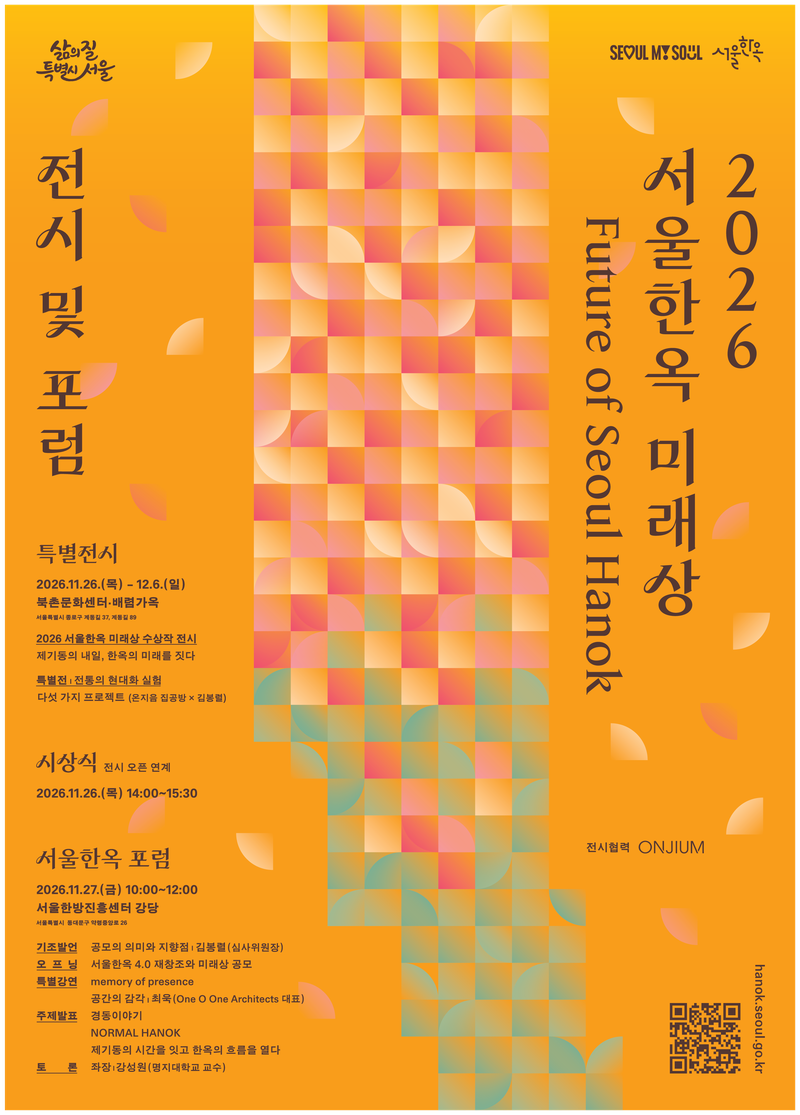
The city said on the 25th that it will hold the special exhibition for the 2026 Seoul Hanok Future Award from the 26th through the 6th of next month.
The exhibition, themed “From Imagination to Practice: Building the Future of Hanok,” will open with an awards ceremony at 2 p.m. on the 26th at Bae Ryeom House in Jongno District. During the event, 12 winning entries from the Future Hanok Design Competition and five built architectural projects demonstrating the contemporary continuation of traditional architecture will be presented at Bae Ryeom House and around the Bukchon Culture Center.
Now in its second edition, the Seoul Hanok Future Award Design Ideas Competition was held under the theme “Tomorrow’s Jegi-dong: Building the Times of Hanok,” with the site covering the area around lot 988 in Jegi-dong, Dongdaemun District, where a traditional market and hanok alley coexist. A total of 70 teams took part in a spirited competition, and 12 works were named winners in recognition of their relevance to the theme, originality and practicality.
The grand prize went to “Gyeongdong Story” (Ryu Hui-pyo and one other), which boldly dismantles and reassembles the hanok structure and combines it with a two-story heavy timber frame to expand the space of traditional hanok in three dimensions. Two works received the Excellence Prize: “NORMAL HANOK” (Song Ha-yong), which proposed through-running and communal daecheong halls that bring the flow of the market into the hanok, and “Connecting Jegi-dong’s Times and Opening the Flow of Hanok” (Kim Min-ji and two others), which presented the idea of a “Big Hanok” combining a low-rise hanok with a vertical tower. “Shopping for Life” and “Building the Time of Hanok” were selected for the Citizen Empathy Special Award through the online public-voting platform M-Voting. The winning entries drew strong public interest, surpassing 80,000 cumulative views within a week of being posted on the competition’s official Instagram account in formats including short-form videos.
The exhibition was conceived to offer a multifaceted look at the potential for contemporary uses of hanok by placing experimental design ideas for future hanok alongside accumulated examples of completed projects.
At Bae Ryeom House (89 Gyedong-gil, Jongno District), the 12 winning entries will be displayed through drawings, models and videos. In particular, the “Table of Inspiration,” which arranges the 12 entries as if they formed a single village, will let visitors compare at a glance the spatial relationships created by the different design ideas across Jegi-dong. In conjunction with this, the Bukchon Culture Center will host a special exhibition, “Five Experiments,” in collaboration with Onjium House Workshop, which has researched the contemporary continuation of traditional architecture. The exhibition will present the results of reinterpreting the values of traditional hanok through contemporary technologies, materials and ways of life, through five architectural projects in Korea and abroad: Baedong Hanok in Gyeongju, the Donuimun Museum Village Hanok Youth Hostel, the Korean Hall in the Cathedral of Learning at the University of Pittsburgh in the United States, Mujungwon and Seonhye-won.
At 10 a.m. on the 27th, the day after the exhibition opens, the Future Hanok Forum will be held in the auditorium of the Seoul Korean Medicine Promotion Center in Dongdaemun District. The program will include keynote remarks by jury chair Kim Bong-ryeol, a special lecture by Choi Wook, CEO of ONE O ONE architects (“memory of presence: The Sense of Space”), and presentations by the three grand prize and Excellence Prize winners. The panel discussion will be moderated by Kang Seong-won, a professor at Myongji University, and will include Kim Dae-gyun, CEO of Chakchak Studio Architects; Choi Jae-young, CEO of The First Penguin; Yu Na-gyeong, CEO of the PMA Urban Environment Research Institute; four award winners; and the head of the Seoul Metropolitan Government’s Hanok Architecture and Heritage Division. They are expected to discuss in depth the vision for Seoul’s hanok and the challenges of design, construction and operation.
Myeong No-jun, head of the Seoul Metropolitan Government’s Housing Office, said, “Hanok can be more than a house that is simply preserved; it can be a home that holds tomorrow.” He added, “I hope this exhibition and forum will be a meaningful occasion to consider the potential for Seoul’s hanok to advance as future urban architecture, as we encounter together experiments realized through imagination and in actual buildings.”
[email protected] Jeon Min-gyeong Reporter