Why Does Roh Soh-yeong Owe 'Zero' Tax Even If Roh Receives 944 Billion Won From Chey Tae-won?
- Input
- 2026-11-25 07:08:24
- Updated
- 2026-11-25 07:08:24
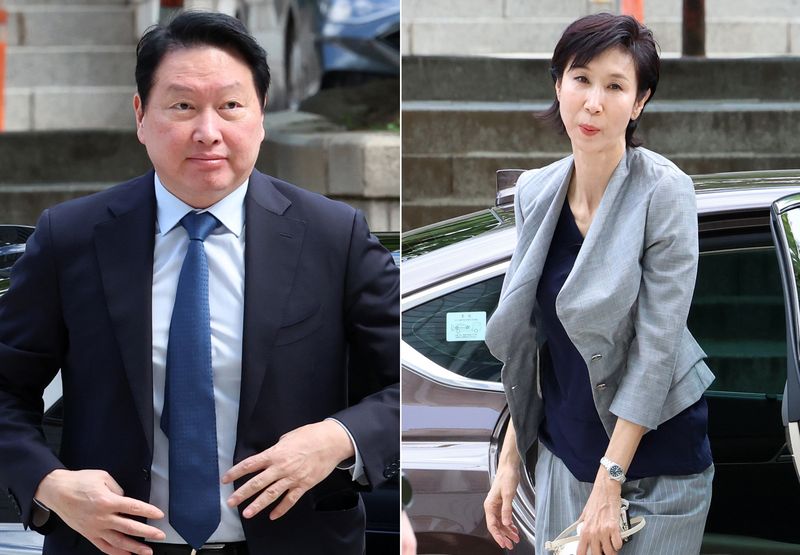
[Financial News] The lawsuit in the “divorce of the century,” which has continued for more than nine years, appears to be nearing its end. Chey Tae-won, chairman of SK Group, has indicated that he will pay Roh Soh-yeong, director of Art Center Nabi, 944 billion won in property division.
Property division in a divorce is different from a gift received free of charge, so no tax is due
Although this is the largest property division in the country’s history, no separate gift tax or income tax is generally due. That is because property division in a divorce involves splitting assets the couple built together, and is different in nature from a gift of property received free of charge. However, if Chey sells shares he holds to raise cash, he will have to pay capital gains tax as a major shareholder.
According to legal sources on the 24th, Chey filed a request for a court-recommended settlement the previous day with the Second Division of the Supreme Court of Korea, which is hearing the second final appeal in the property division case, with Justice Kim Seong-su as the presiding justice. The request indicates his intention to pay Roh the 944 billion won in property division awarded in the remand trial.
The remand trial had ruled in July that the property division should be split two-thirds to Chey and one-third to Roh, and ordered Chey to pay Roh 944 billion won. Chey alone challenged the ruling and filed a further appeal to the Supreme Court. The 2 billion won in damages had already been finalized by the Supreme Court in October last year.
According to the National Tax Service, property division following a divorce is not subject to gift tax. It is viewed as a “settlement” in which each spouse gets back their original share of the assets they accumulated together during the marriage. The reasoning is that although the assets were in the other spouse’s name, they were substantively one’s own property, and therefore cannot be considered either a gift received from someone else for free or newly earned income. The agency also explained that damages for emotional distress are generally not taxable, and that cases in which they are taxed are extremely rare.
However, gift tax may be imposed if someone receives money as damages before the divorce is legally finalized, or if the couple reunites after the divorce and it is determined that the obligation to pay damages has ceased. If damages are transferred as real estate instead of cash, the person transferring the property must pay capital gains tax. Since Roh will receive cash rather than real estate, no acquisition tax issue arises.
The ruling also reduced the tax burden by ordering payment in cash instead of shares. The court recognized the SK shares held by Chey as subject to division, but, considering that they underpin management rights and control, ordered him to pay Roh’s share in cash rather than transfer the shares.
Chey faces capital gains tax if he sells shares
Chey, who is required to pay the money, could face a tax burden. If he sells shares he holds to raise the funds for the property division payment, he must pay capital gains tax on the transfer, regardless of the purpose of the sale. Ordinary small shareholders do not pay capital gains tax on listed shares, but Chey is taxable because he meets the criteria for a major shareholder.
The prevailing view in business circles is that Chey is unlikely to sell his stake in SK directly and risk concerns about a potential overhang of shares for sale and weakened control of the group. Instead, using the proceeds from selling his stake in SK Siltron and covering any shortfall with stock-backed loans, dividends and cash equivalents is widely seen as the likely approach. Borrowing against shares or receiving dividends does not transfer ownership of the shares, so no capital gains tax arises.
[email protected] Kim Hee-sun Reporter