Criticism Mounts Over Trump’s Intervention in Jensen Huang’s Return ... “State Capitalism and Maoism”
- Input
- 2026-11-25 06:44:34
- Updated
- 2026-11-25 06:44:34
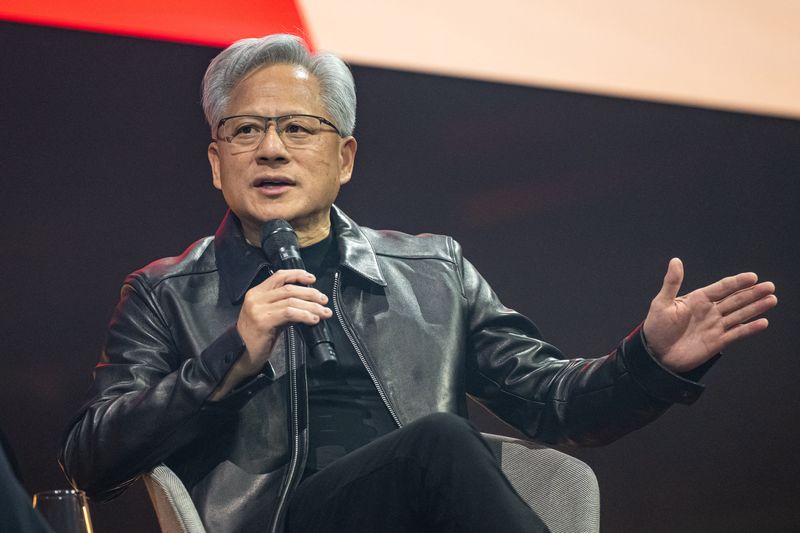
[Financial News] U.S. media have poured out criticism of the abrupt return of NVIDIA CEO Jensen Huang, who had stepped down amid an affair scandal involving a woman suspected of being a Chinese spy, calling it “state capitalism” (State Capitalism).
The fact that U.S. President Donald Trump intervened with NVIDIA’s board to press for Jensen Huang’s return as CEO, calling him “a great patriot, a national treasure”—a businessman close to Trump and a major donor—can only be seen as state capitalism, in which the government controls corporate decision-making.
The Wall Street Journal (WSJ), in an editorial titled “NVIDIA and Trump’s State Capitalism,” said on the 24th, local time, that “the soap opera surrounding NVIDIA took another dramatic turn with the board’s announcement that Jensen Huang would return as CEO.”
It criticized the move, saying, “(President Trump) is undermining all manner of political norms, and his intervention to rescue Huang is yet another regrettable example of state capitalism.”
Another example of Trump’s state capitalism: the federal government’s acquisition of a stake in Intel
Another example of state capitalism in the Trump era is the pressure on Intel CEO Lip-Bu Tan to resign and the federal government’s acquisition of a stake in Intel. After allegations emerged of links between Tan and Chinese companies, President Trump pressured him to resign, and Tan handed the government a 9.9% stake in Intel in exchange for keeping his job.
Whenever he had the opportunity, President Trump touted the government’s acquisition of a stake in Intel and Intel’s rising stock price as achievements. At the time, he said, “I would make that kind of deal—the government’s acquisition of a stake in Intel—for our country all day long,” openly signaling his willingness to acquire stakes in companies in other industries as well.
WSJ pointed out that the boundary between corporate management and state power at NVIDIA was already “blurred” and had effectively disappeared with the decision to reinstate Huang as CEO. The comment referred to Huang persuading President Trump to allow NVIDIA to sell its H200 chips in China in exchange for turning over some of the sales revenue to the U.S. government.
WSJ chief economics commentator Greg Ip pointedly observed that NVIDIA had become a government-sponsored enterprise (GSE), like Fannie Mae and Freddie Mac, in which the federal government determines a company’s goals and governance.
He noted that “by aligning its interests so closely with Trump, NVIDIA has become a prime example of the trend of the United States shifting toward state capitalism,” thereby laying the groundwork for “the conditions in which this scandal could occur.”
The Washington Post (WP): White House has acquired stakes in more than 36 U.S. companies
The Washington Post (WP) noted that Trump’s intervention at NVIDIA had added another contradiction to his record: since returning to the White House, he has wielded the government’s power to intervene heavily in the free-market economy while repeatedly labeling his political adversaries “socialists.”
According to WP, the White House has already acquired stakes in more than 36 U.S. companies. Last year, it also spearheaded corporate deals, including the sale of the social media app TikTok. Experts have expressed concern that if government intervention becomes entrenched, it could undermine the free-enterprise system.
Yale School of Management professor Jeffrey Sonnenfeld likened the Trump administration’s actions to Mao Zedong’s regime during China’s Cultural Revolution, remarking, “That’s not capitalism; it’s Maoism.”
Professor Sonnenfeld warned that once business executives regard government officials’ intervention as a constant, they will make decisions for political rather than business reasons, undermining innovation in the United States.
In an editorial, WSJ mocked, “We are beginning to understand why Trump thinks so highly of Xi Jinping. He likes the way China’s top Communist Party leader can order private companies around and ignore the law when it serves his purposes.”
The New York Times (NYT): Trump “did not care about national security concerns or private-sector autonomy”
The Trump administration’s move to legitimize the NVIDIA board’s decision also came under fire. After the scandal involving CEO Huang broke early this month, the administration thoroughly investigated whether export-control rules on China had been violated, then said, “There is no reason to believe Jensen’s return poses a risk to national security.”
The New York Times (NYT) reported that “the move, which appears to have traded long-term national security concerns for short-term stock gains, sent shock waves through Washington, Wall Street and Silicon Valley.”
NYT noted that President Trump had gone out of his way to ignore intelligence agencies’ warnings that Huang’s affair partner was suspected of being a Chinese spy, adding, “(He) did not care about national security concerns or private-sector autonomy.”
WSJ called it “surely the fastest ‘very thorough investigation’ in history,” adding that it “suggests Trump assured the board that the administration would not punish NVIDIA for potential violations of export-control rules or securities laws.”
[email protected] Lee Seok-woo, international affairs specialist Reporter