KAI to Integrate Drones With Its Mainstay Fighter Jets
- Input
- 2026-11-25 18:06:23
- Updated
- 2026-11-25 18:06:23
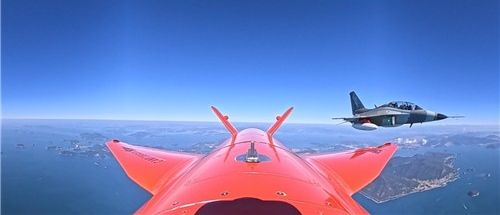
[Financial News] Korea Aerospace Industries (KAI) is going beyond simply developing drones, seeking to integrate them with its mainstay fighter jets to strengthen its competitiveness.
A key drone strategy emerging from modern warfare is to deploy large numbers of low-cost, attritable drones while completing missions in coordination with manned forces. In this regard, KAI is making full use of its position as the country’s only complete-aircraft systems integrator to integrate drones with the FA-50 and the Korean fighter KF-21.
With fighter integration in mind, KAI has secured its own unmanned aircraft platforms and key operational technologies. Notable examples include the fighter-cooperative unmanned combat aircraft (MUCCA) and the multipurpose unmanned aircraft SUCA and AAP. AAP is a high-speed, jet-powered unmanned aircraft in the 150-kg class developed in-house by KAI, with a top speed of 790 kilometers per hour. It is designed to keep pace with fighter jets maneuvering at high speeds.
AAP enters enemy threat areas ahead of manned fighter jets. It uses reconnaissance and surveillance to locate enemy air defenses in advance, then disrupts enemy radar and detection-and-tracking systems with electronic warfare and deception missions. Meanwhile, manned fighter jets carry out precision strikes from a safe distance. This protects pilots while also increasing the chances of mission success.
This operational concept is not merely theoretical. In 2023, KAI began research into aircraft control technology, one of the more challenging areas of AI pilot technology. In 2024, it demonstrated AI for flight and obstacle avoidance using commercial drones. Since the beginning of this year, it has been conducting flight demonstrations with AAP. Last month, the FA-50 and AAP successfully flew in formation for 20 minutes, maintaining a distance of 9–30 meters. In effect, operational deployment of drones integrated with fighter jets is imminent.
KAI is also preparing a low-cost, attritable-drone strategy that has come to the fore in the war in Ukraine. Going beyond simply loading unmanned aircraft with explosives, it has combined AI technology to give them autonomous flight, battlefield situational awareness, target detection and identification, and mission execution capabilities. Applying AI is significant because the drones can carry out strikes independently even when subjected to jamming (radio interference). This approach is suited to the large-scale acquisition of Korean long-range suicide drones, which the South Korean military is seeking to field early, before 2030.
[email protected] Kim Yun-ho Reporter