Hanwha Aerospace Pursues Unmanned Systems and the Unmanned Conversion of Existing Weapon Systems
- Input
- 2026-11-25 18:06:08
- Updated
- 2026-11-25 18:06:08
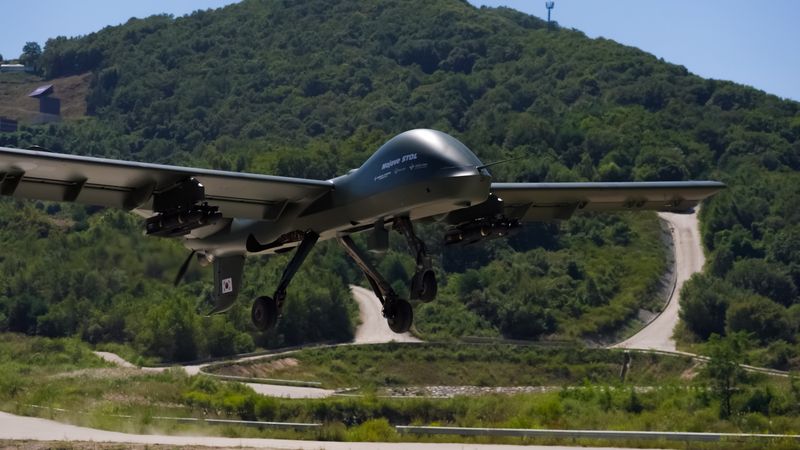
[Financial News] Hanwha Aerospace is pursuing not only the development of unmanned aircraft and vehicles amid global competition in unmanned systems, but also the selective conversion of existing weapon systems, including the K9 Thunder self-propelled howitzer, for manned or unmanned operation.
Among the main unmanned systems unveiled by Hanwha Aerospace are the short takeoff and landing drone Gray Eagle STOL, the wheeled 40mm anti-drone air defense system (WAAG), and the Arion-SMET multipurpose unmanned ground vehicle. Gray Eagle STOL is an unmanned aircraft that has been under joint development with U.S.-based General Atomics Aeronautical Systems, Inc. (GA-ASI) since 2025. The goal is for the aircraft, which can carry one ton, to take off and land within a distance of 100 to 300 meters using high-lift devices and a 450-horsepower-class turboprop engine. Aircraft in the same class typically require a runway at least one kilometer long.
Mojave has already achieved a substantial portion of its targeted performance. Last September, at the Defense Drone Technology Exhibition held in Pocheon, Gyeonggi Province, under the auspices of the Ministry of National Defense, it took off and landed on a narrow tank maneuver route rather than a regular runway. In November 2024, it successfully took off from a distance of less than 100 meters on the flight deck of the Navy’s ROKS Dokdo.
WAAG, designed to defend against drones, was introduced at Industry Day, held last month in Vilnius, Lithuania. It is a mobile, vehicle-mounted version of an intelligent 40mm unmanned air defense system developed to protect South Korean forces against incursions by unmanned aircraft. It analyzes threats from drones and unmanned aircraft, determines engagement priorities and responds through automated procedures. An optical tracking system enables it to engage within seconds.
The Arion-SMET unmanned ground vehicle has entered the mass-production phase and is slated for operational deployment with the South Korean military. It is a third-generation model, following the first generation in 2016 and the second in 2023. The second-generation model had already passed the U.S. Foreign Comparative Testing (FCT), certifying its performance. With a payload capacity of 450 kilograms, it features AI-based remote weapon control and autonomous off-road driving. Exports to Romania, Finland, Canada and other countries are also said to be imminent.
In addition to developing these unmanned systems, Hanwha Aerospace is pursuing the selective conversion of existing weapon systems for manned or unmanned operation. The goal is to convert the K9 Thunder, the K239 Chunmoo multiple rocket launcher and the next-generation infantry fighting vehicle into selectively manned-unmanned systems by 2029. The company also plans to apply manned-unmanned teaming technology to the 120mm self-propelled mortar, the Marine Corps’ amphibious assault vehicle and the combat engineer vehicle.
[email protected] Kim Yun-ho Reporter