Budget Subcommittee Defers Review After Clash Over Blue House Special Activity Funds... Opposition: “Must Apologize for Double Standards”; Ruling Party: “First-Ever Disclosure”
- Input
- 2026-11-24 22:56:29
- Updated
- 2026-11-24 22:57:20
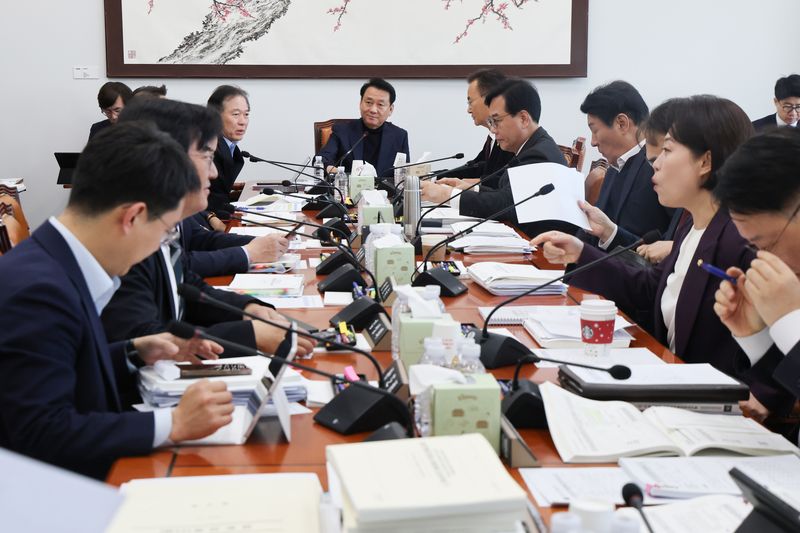
[Financial News] The ruling and opposition parties clashed head-on on the 24th over next year’s Blue House special activity funds and state publicity budget at the Budget Bill Adjustment Subcommittee of the National Assembly’s Special Committee on Budget and Accounts. Unable to bridge their differences over major disputed budget items, the subcommittee deferred review of many of them and effectively shifted to negotiations through a “small subcommittee.”
■ Fierce battle over 8.25 billion won in Blue House special activity funds... “Double standards” vs. “security constraints”
At the subcommittee meeting that day, the People Power Party strongly challenged the Blue House’s allocation of 8.25 billion won for next year’s special activity funds. Na Kyung-won, a People Power Party lawmaker, called on the Democratic Party to apologize, saying, “It is truly a case of double standards for the Democratic Party, which cut all of the Presidential Office’s special activity funds under the Yoon Suk Yeol administration two years ago, to approach the review this way.” She went on to urge the government to explain the reasons for the increase compared with the previous administration and submit relevant documents, saying, “Saying that it will disclose this year’s special activity fund disbursement records only in January 2027, after review of next year’s budget bill has ended, would hollow out the National Assembly’s budget review authority.”
Yoo Sang-bum of the People Power Party, the opposition’s committee secretary on the SCBA, also argued, “The Presidential Office continues to refuse to submit documents on the selection of projects and offers no explanation,” adding, “This is effectively an obstruction of the review of both the accounts and the budget, and official business expenses need to be cut.”
In response, Yoon Ki-cheon, the Blue House’s chief secretary for general affairs, explained, “Please understand that it is difficult to disclose all the details of special activity fund disbursements,” adding, “The Blue House senior secretary for political affairs formally apologized when the special activity funds were reinstated in 2025.” Jung Tae-ho, the Democratic Party’s committee secretary for the ruling party, countered that “the Presidential Secretariat is disclosing the relevant information for the first time among successive administrations, in accordance with the law and court rulings,” and argued for keeping the original proposal, saying, “Many matters require security, and there are differing legal interpretations regarding the submission of documents.”
In the end, Lee Gwang-jae, the Democratic Party’s chair of the Special Committee on Budget and Accounts and the subcommittee chair, deferred review of the special activity funds, saying, “This debate goes on endlessly. We have asked the chair of the Board of Audit and Inspection to establish reasonable standards, and a broad agreement among political circles is needed.”
■ Clashes also over souvenir, cooperative and AI training budgets... disputed programs deferred one after another
The parties also continued to spar over the Blue House budget for managing state affairs and major programs at various ministries. Song Eon-seok of the People Power Party criticized the additional allocation of 720 million won for souvenirs for Blue House visitors, saying, “It is a pork-barrel giveaway and, to put it strongly, could amount to campaigning before an election.” By contrast, Kim Seong-hoe of the Democratic Party asked that the original proposal be retained, saying the spending would “increase transparency in budget management and create more opportunities for communication with the public.”
The budget for supporting cooperatives and social enterprises also came under scrutiny. People Power Party lawmakers Song Eon-seok and Seo Ji-young criticized the 33-fold increase in government contributions to the Korea Social Enterprise Promotion Agency for supporting cooperatives, from 2.4 billion won this year to 79.8 billion won next year, calling it “inflated election handouts.” Na Kyung-won called for ensuring the cooperatives’ self-sufficiency. In response, Democratic Party lawmaker Jeon Jin-suk emphasized the need for continued state support, while an official from the Ministry of Planning and Budget said, “We will do our utmost to ensure efficient implementation.”
Song also criticized the Presidential Security Service for allocating 3.966 billion won in facility repair funds to projects protecting key figures and state guests, saying it was “playing games with the budget.” The service said the allocation was unavoidable because of building safety concerns that emerged at the final stage of budget preparation. The Ministry of Employment and Labor’s vocational training and youth employment programs in the artificial intelligence (AI) sector were also sent back for further review, after People Power Party lawmaker Lee Jong-wook pointed out that “at least 20 million won is being spent per person, yet the employment rate is only 23%,” while Democratic Party lawmaker Kim Gyo-heung and Vice Minister of Employment and Labor Kwon Chang-jun countered that the programs were “essential to resolving the shortage of workers for AI transformation (AX) at small and medium-sized enterprises.”
■ Disagreement over review of the “Future Response Fund”... negotiations effectively begin in a small subcommittee
The ruling and opposition parties also sparred over how to review the “Future Response Fund.” Yoo Sang-bum argued, “Although the Strategy and Finance Committee is reviewing the bill to establish the fund, the SCBA should separately conduct a substantive review of the merits of individual projects and whether their budgets should be cut, and the funds should be returned to existing accounts and funds.” Jung Tae-ho countered, “It is the People Power Party that has consistently argued that individual projects cannot be reviewed before a legal basis is in place,” adding, “The procedure is to discuss the matter after it passes the Strategy and Finance Committee.”
Before the subcommittee adjourned that day, the ruling and opposition parties held a “four-way meeting” involving the committee secretaries from both parties on the SCBA and the Strategy and Finance Committee, and effectively began negotiations through the unofficial consultative body known as the “small subcommittee.” However, with the parties far apart on key disputed budget items, including the special activity funds and the Future Response Fund, considerable difficulties are expected in the negotiations ahead.
[email protected] Park Ji-hyun Reporter