Retail Investors, Can They Breathe a Sigh of Relief? Analysts Weigh In as KOSPI Surges 6%
- Input
- 2026-11-25 06:00:00
- Updated
- 2026-11-25 06:00:02
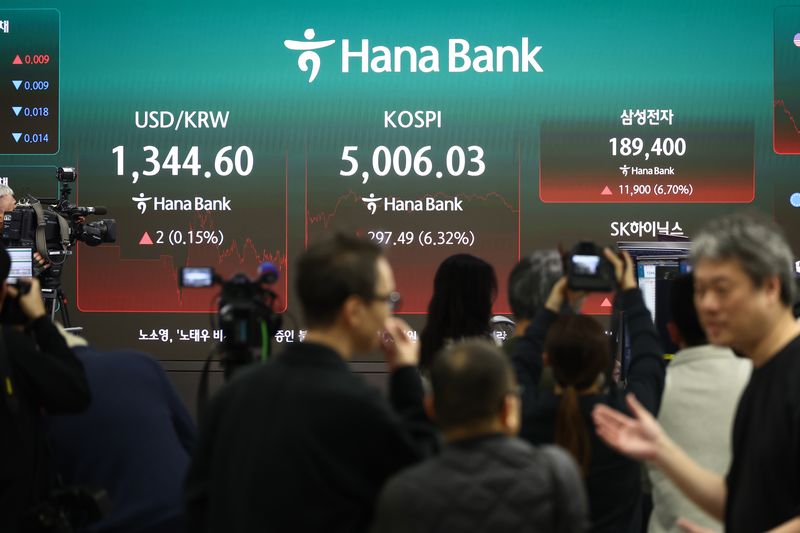
[Financial News] An expert analysis says South Korea’s stock market may have reached the bottom of its downturn after KOSPI surged more than 6% on news of NVIDIA CEO Jensen Huang’s return. Foreign investors’ selling is also easing compared with before, but it is too early to conclude that the market has shifted into a full-fledged uptrend, the analysis says.
Appearing on YTN Radio on the 24th, Choi Hong-seok, head of the ETF Division at Woori Asset Management, analyzed the factors behind the rebounds in U.S. and South Korean stock markets following news of CEO Huang’s return and offered an outlook for future stock movements.
Choi said KOSPI’s surge of more than 6% that day was a partial reversal of recent losses: “The Korean stock market fell by a little over 8% over the past two days, so some of that is being reversed.” He added that further gains were possible, as expectations for a rise in the U.S. market had not yet been fully reflected in the domestic market.
He pointed to the U.S. midterm elections and scandals surrounding CEO Huang as major causes of the recent steep market decline. The analysis is that investor sentiment was sharply weakened by political uncertainty and controversies involving corporate leadership, rather than by a deterioration in companies’ earnings or fundamentals.
“I think the forced selling caused by the sharp decline has, to some extent, run its course,” he said. “From here, the market will be affected by economic conditions related to companies’ earnings and fundamentals, and these factors are not bad. So I think we can say that we have, to some extent, confirmed the bottom.”
However, he said it would take more time to see whether CEO Huang’s return would lead to a full-fledged rise in the stock market. Some concerns about circular investment in artificial intelligence (AI) amid the CEO vacancy and about NVIDIA’s leadership have eased, but issues facing the AI industry, including uncertainty surrounding data centers, remain.
Choi also said of the U.S. market’s rebound, “The S&P 500 has rebounded about 5% after a correction of just under roughly 15%,” adding, “I think one could say it is still too early to call this a decisive rebound or an uptrend.”
He assessed that foreign investors’ selling, one of the major causes of the decline in the domestic market, was easing compared with before. According to Choi, foreign investors sold about 14 trillion won over the past 20 trading days and about 60 trillion won over the past three months.
“As recently as October, selling totaled around 30 trillion won. Now it has fallen to about 14 trillion won. They are still selling, but we can say the selling pressure has passed its peak and is weakening,” he explained.
However, he said it would be difficult for a clear wave of buying to come in by the end of the year, even though the scale of foreign investors’ selling had declined. “Perhaps next year will be when this turns into foreign buying, as we had hoped,” he forecast.
He also gave a positive assessment of government policies aimed at addressing the undervaluation of the domestic stock market, including amendments to the Commercial Act. Choi said such policies “could in fact play a significant role in making market supply and demand more favorable over the medium to long term,” adding that they could help attract investment funds over that period.
He advised individual investors to first review the proportion of their portfolios invested in stocks they currently hold, rather than react to short-term price fluctuations. “Rather than worrying about today or tomorrow, first check whether your position is manageable, and I think it may be better to take a long-term view whenever opportunities arise,” he advised.
Meanwhile, KOSPI closed at 5,006.03 that day, surging 297.49 points (6.32%) from the previous trading day. It was the first time in three trading sessions that the index had regained the 5,000 level at the close.
[email protected] Han Seung-gon Reporter