At 22, She Earned 78 Million Won a Month... Lee Kyung-ae on Why She Lost Her Entire Fortune
- Input
- 2026-11-25 04:40:00
- Updated
- 2026-11-25 04:40:02
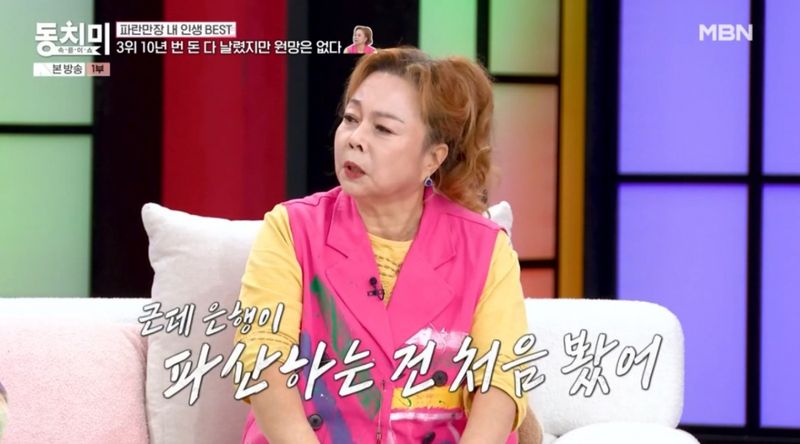
[Financial News] Comedian Lee Kyung-ae, 62, said she earned tens of millions of won a month at the height of her career but lost all the wealth she had accumulated over 10 years during the 1998 International Monetary Fund (IMF) financial crisis. She also shared how, after trying her hand at business several times, she ended up closing all 10 of the businesses she had operated.
The MBN variety show Dongchimi, which aired on the 21st, featured the theme “You Wouldn’t Know How Tumultuous It Was.”
Lee Kyung-ae, who appeared on the show that day, talked about her heyday as a comedian in the 1980s, when she filmed around 20 commercials, and the financial difficulties she faced later.
Recalling her debut, Lee Kyung-ae said, “I was the first comedienne to appear on television on my own. Senior Shim Hyung-rae won the grand prize in the first KBS comedy contest, and I won it in the second. Before that, contestants were all selected through radio. For the first time, they broadcast (the scene of me winning the grand prize). The ratings were over 50% at the time.”
She recalled her popularity, saying, “I had to change buses three times to get home, but I could hardly get on one. People were grabbing me on the bus and making a scene.” She said, “After I did comedy in a North Korean dialect, things eased up,” and then demonstrated the dialect on the show.
But unlike her glamorous broadcasting career, she said she had faced financial hardship several times. Lee Kyung-ae described how she went from supporting her family to losing her wealth, saying, “I lost everything I earned over 10 years and all 10 of my shops, but I don’t resent anyone.”
Lee Kyung-ae said she had to help cover her family’s living expenses even before she debuted as a comedienne. She explained, “My father was an office worker, but his monthly salary was far below what I earned in a month as an extra. He retired at the mandatory retirement age the year before I became a comedienne, and all his severance pay went toward a semi-basement apartment, so I had to cover all our living expenses, including my younger siblings’ education.”
But her broadcasting fees at the time were not enough to support a family of seven. She confessed, “I needed to earn money quickly, but the pay for an extra was 9,900 won. I worked four times a month, so it came to less than 50,000 won. That wasn’t even enough to pay for rice for seven people.”
Lee Kyung-ae’s income rose dramatically when she started working as a nightclub DJ. She had always been interested in music, and after winning the grand prize in a comedy contest, she learned to DJ and took on a new line of work.
She said her income rose sharply: “At first, I only mixed music. I was paid 300,000 won when I didn’t do any MCing, but two years after I started making announcements, I was earning 13 million won. I did six nightclub gigs a day that paid 13 million won each.” She added, “My monthly performance fee was 78 million won, and I got 15 million won for regional events over the two weekend days. I was 21 or 22 then.”
After she began earning a substantial income, Lee Kyung-ae suggested to her father that they buy a home in Gangnam, Seoul. But her father, who thought stock investments were safer than real estate, did not agree, she said.
Lee Kyung-ae explained why her father had been reluctant to invest in real estate: “At the time, a famous apartment in Apgujeong cost 120 million won. I told my father, ‘Home prices in Gangnam will rise more than in Gangbuk, so let’s settle in Gangnam.’ But he said, ‘I was the son of a wealthy family in the North. Our house had 99 rooms, but when war broke out, I couldn’t bring any of it with me. Land doesn’t make money.’”
Her father also preferred stocks because he had once seen the share price of a company he worked for rise sharply. She said, “Back then, shares in the company my father worked for were expensive. The shares worth 5,000 won that the company gave its employees went up tenfold. My father said, ‘The safest stocks are bank stocks,’ and invested everything he earned in them.”
She said she trusted her father, who lived frugally, and left him in charge of managing all her earnings. Lee Kyung-ae said, “My father wore just one leather jacket. He never wasted money. He would always tell me, ‘Kyung-ae, just hang in there a little longer. Dad will make sure you can live without having to struggle,’ so I trusted him and handed everything over to him.”
Things changed during the 1998 IMF financial crisis, when the bank her father had invested in was designated for closure. The wealth Lee Kyung-ae had earned over 10 years through broadcasting and events also disappeared, she said.
Lee Kyung-ae said, “That was the first time I’d seen a bank go bankrupt,” and revealed that her parents also developed health problems after the failed investment. She added, “My father developed stomach cancer from stress within a few years. My mother developed cirrhosis of the liver.”
Lee Kyung-ae said she did not resent her father for the loss of their wealth. She said, “At the time, I thought, ‘I can just earn it again.’ I thought, ‘If something doesn’t work out, that’s fate,’ and, ‘I’m not getting this money because I wasn’t good enough.’ I still look good, don’t I?”
After losing her wealth through stock investments, she ventured into several businesses, including restaurants, but things did not go smoothly there either. Lee Kyung-ae said she had closed all 10 business locations she had operated.
She explained, “Because of COVID-19, my building was shut down for at least a month. I closed 10 businesses: tteokbokki, fish cakes, three izakayas, a Thai massage parlor, three tteokbokki shops, and finally a café and pub. It’s been two years since I ran those businesses into the ground.” She added, “I have no regrets because I’ve tried things not everyone gets the chance to try.”
[email protected] Han Seung-gon Reporter