'Second MLB' Dreams Drive K-Fashion's Renewed Push Into China
- Input
- 2026-11-25 08:45:07
- Updated
- 2026-11-25 08:45:07
[Financial News] Fashion companies are once again turning their attention to the Chinese market. Although China's consumer recovery remains slow, they are moving to gain a foothold early, taking into account expectations for improved Korea-China ties and the growth potential of China's vast consumer market.
Industry sources said on the 25th that more domestic fashion brands have recently been entering China or increasing the number of stores they already operate there.
F&F's MLB plans to operate 1,094 stores in China this year, an increase of 16. Discovery Expedition will add three stores this year, bringing its total to 27. Kolon Sport, operated by KOLON Industries FnC, aims to add up to 20 stores by the end of the year, bringing its total to 230. XEXYMIX, which entered China in 2024, had expanded its store count to 30 by last year.
More companies are also making their first moves into the Chinese market. Juun.J, part of Samsung C&T Fashion Group, opened stores in Chengdu and then Beijing starting last July, and opened its third store in China, in Macau, early this month. It plans to continue opening stores next year. Matin Kim, operated by Hago Haus, recently opened its first store in mainland China and plans to increase its total to four by the end of the year. Helinox Wear, part of KOLON FnC, aims to open two stores in Shanghai by the end of the year and increase its store count in China to 30 by 2030.
For some time, China was seen as barren ground for Korean consumer goods because of the Hallyu ban (China's restrictions on Korean Wave content) and a sluggish domestic market. Fashion companies that benefited from a brief period of rapid growth in the 2010s also ran into difficulties after a few years. E-Land World, considered one of the first-generation fashion companies to enter China, saw combined sales at its three Chinese fashion subsidiaries reach 2.9 trillion won in 2015, at one point exceeding its domestic sales. Since then, E-Land World's fashion sales in China have declined every year, remaining in the range of 950 billion won last year.
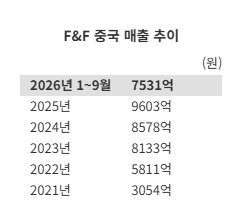
However, the Chinese market is attracting renewed interest as more fashion brands, including F&F, establish themselves there. MLB, which entered China in 2019 just before the pandemic, is seen as having succeeded with its wholesale-based approach, leveraging U.S. intellectual property (IP). Through rapid expansion, F&F's sales in China rose from 300 billion won in 2021 to 960 billion won four years later, more than tripling.
China's sluggish consumer market remains a negative factor. According to the Korea Trade-Investment Promotion Agency (KOTRA), China's retail sales grew 3.7% last year, remaining in the 3% range for the second consecutive year. That was roughly half the 7.2% growth recorded in 2023, and the rate fell to 1.1% through the first three quarters of this year. F&F's rapid growth also cooled, with its sales growth in China remaining in the low teens last year.
It is also positive that expectations for the lifting of the Hallyu ban are growing, with a free trade agreement (FTA) reaching a substantive conclusion following the recent South Korea-China summit.
A fashion industry official said, “With consumer spending in China showing little sign of recovery, we cannot expect the kind of strong growth there that we saw before,” but added, “As the largest market in the region, China remains an important market and a place we should continue to pursue.”
[email protected] Kang Myeong-yeon Reporter