AI Company, Not a Game Company, Becomes G-Star's Main Sponsor... Expanding Its Reach to Webtoons, Fashion and Cars
- Input
- 2026-11-24 16:00:22
- Updated
- 2026-11-24 16:00:22
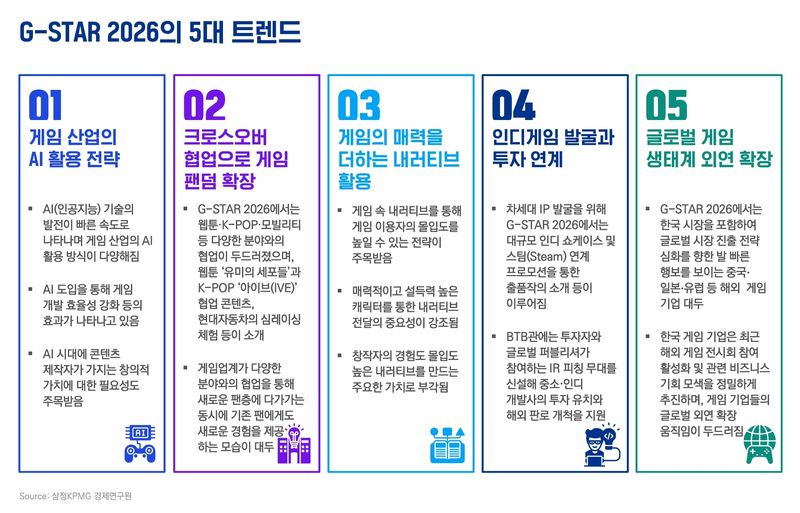
According to a report published on the 24th by Samjong KPMG, the five major trends in the gaming industry seen at G-STAR this year are strategies for using AI; expanding fandom through cross-industry collaboration; using narrative; discovering indie games and connecting them with investment; and expanding the global gaming ecosystem.
The most notable change at G-STAR 2026, held from the 19th to the 22nd at the Busan Exhibition and Convention Center (BEXCO), was the rise of AI companies. AI company Wrtn Technologies took part as the first non-gaming company to serve as G-Star's main sponsor, promoting its AI story-creation platform Crack. The report said, “Innovative cases of AI-powered game development, such as Unbound and Mesh, have also emerged,” and analyzed that “AI is establishing itself as a factor determining production efficiency and content competitiveness, going beyond a simple development aid.”
The gaming industry's strategy for building fandom is also changing. This year at G-Star, collaborations took place with the webtoon IP Yumi's Cells and fashion platform KREAM. Hyundai Motor also hosted the final of the Hyundai N Virtual Cup and operated a virtual car-racing (sim racing) experience zone. The aim is to combine games with webtoons, fashion and mobility to broaden consumer engagement beyond existing game users.
Speakers at the G-Star conference also included Shoji Kawamori, director of the Japanese animated Macross series, as well as global game companies CD Projekt Red and Supergiant Games. As the boundaries between games and video content become less distinct, the importance of narrative and direction in deepening user immersion is growing, the report explained.
A total of 108 developers from Korea and abroad took part in this year's G-Star Indie Showcase. A new investor relations (IR) stage, G-Star Investment Connect, was added to the business-to-business (B2B) exhibition hall. This provided small and indie developers with a channel to connect directly with investors and publishers.
Global game companies are also stepping up their efforts to enter the Korean market. Chinese game company HoYoverse set up a large booth and held the first offline demonstrations in Korea of its new titles Petit Planet and Honkai: Nexus Anima. The newly launched Global Game Showcase this year featured Japan's Sega Corporation and Capcom, China's NetEase Games, and Poland's CD Projekt Red, among others.
Kang In-hye, Samjong KPMG's Tech, Media and Content Industry Leader (Vice President), said, “This year's G-Star broadened the scope of the exhibition with the participation of AI, webtoon and mobility companies,” adding, “The gaming industry is expanding its ecosystem by collaborating with a range of fields, including webtoons, fashion and mobility.”
[email protected] Kim Hyun-jeong Reporter