Overseas Construction Orders Plunge 41%... Samil PwC: “Assess Risk-Adjusted Margins, Not Order Value”
- Input
- 2026-11-24 15:53:20
- Updated
- 2026-11-24 15:53:20
According to “Bridging the Uncertainty Gap in EPC Projects,” a report published by Samil PwC on the 24th, cumulative overseas construction orders through the end of October this year totaled $24.73 billion, down 41.1% from the same period last year. Orders in the Middle East, the key market for domestic construction firms, fell 45.9%.
The problem is that as competition for contracts intensifies, construction firms become more likely to accept unfavorable terms that leave them bearing the risk of rising costs. The gap between construction costs estimated at the time of bidding and actual costs is also widening due to skilled labor shortages, supply chain fragmentation, tariffs and inflation.
The report said, “One domestic engineering and construction company, for example, recognized losses of 1.77 trillion won in the fourth quarter of 2024 due to cost overruns on overseas projects, among other factors.” A global engineering and infrastructure company also recently recognized more than $300 million in pretax losses on a single construction management (CM) project it won in 2019. Approximately $36.8 billion was spent on Units 3 and 4 of the Vogtle nuclear plant in the United States, more than 2.5 times the initial budget of $14 billion.
The report pointed out that “the problem is not fixed-price contracts themselves, but the practice of transferring risks that have not been adequately identified to contractors.” It added that tariffs in particular can change at short notice for specific countries and products, potentially undermining the very assumptions used to set bid prices.
In response, contract models that delay the finalization of construction costs or share risks between owners and contractors are gaining ground in the global engineering, procurement and construction (EPC) market. Examples include engineering, procurement and construction management (EPCM), early contractor involvement (ECI), target-price contracts and open-book estimates. Global EPC firms such as Fluor, Bechtel and Worley are also managing the risk of losses by tightening their bid review criteria, separating risk scopes and finalizing prices in stages.
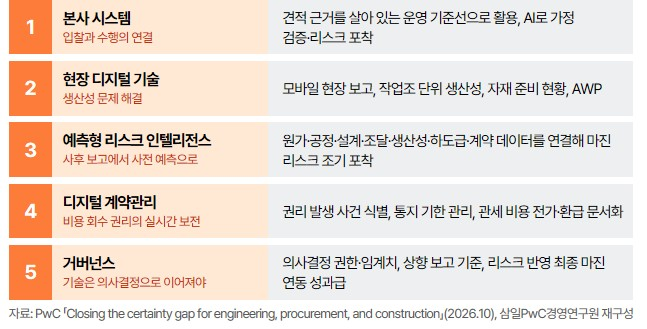
The report also said digital operating systems are needed to identify potential losses arising on site before they are recorded in financial statements. Losses caused by material shortages, schedule delays and declining productivity accumulate on site before they are reflected in enterprise resource planning (ERP) systems.
Samil PwC proposed several strategies for domestic construction firms to protect profitability: diversifying contract structures; building systems for early detection of site risks; strengthening systems for preserving contractual rights and recovering costs; and linking project performance to bid review and compensation systems.
Han Jae-sang, construction practice leader (partner) at Samil PwC, said, “The more volatile order wins are, the more important it is to first assess whether you can generate profits within the risks you can control, rather than focusing on the size of orders.” He added, “Companies with contract structures that set prices in line with design maturity and systems that connect site data to headquarters’ cost and contract management will be able to protect their profitability.”
[email protected] Kim Hyun-jung Reporter