Nematodes Born to Younger Mothers More Sensitive to Danger Signals
- Input
- 2026-11-24 16:01:25
- Updated
- 2026-11-24 16:01:25
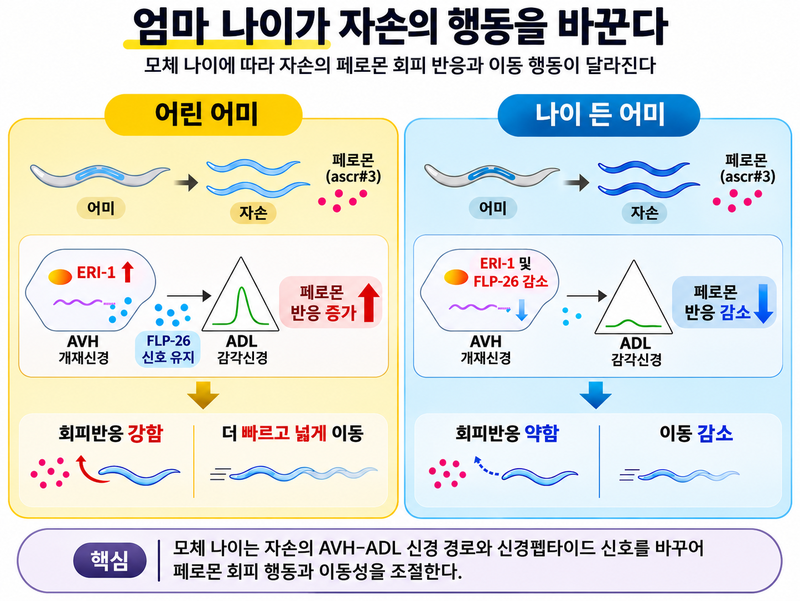
[Financial News] Animal experiments have confirmed that offspring born to younger mothers respond more sensitively to danger signals and travel farther.
A research team led by Professor Kim Gyu-hyeong of the Department of Brain Sciences at Daegu Gyeongbuk Institute of Science and Technology (DGIST) used Caenorhabditis elegans to uncover how a mother’s age affects her offspring’s behavior at the levels of gene regulation and neural circuits, the team said on the 24th. The researchers also established that these behavioral differences arise through small RNAs and signaling between neurons. The findings are seen as offering a new clue to understanding how parents’ physiological state affects the behavior of the next generation.
According to the research team, Caenorhabditis elegans detects its surrounding environment through chemical signals called pheromones. In particular, the pheromone ascr#3, which is secreted when the worms are crowded, triggers an avoidance response that prompts them to move away from one another in unfavorable environments.
The research team compared offspring born to mothers that were one, two, or three days past reaching adulthood. The younger the mother, the stronger the offspring’s avoidance response to the pheromone, and activity was also higher in the sensory neurons that detect it. By contrast, there was little difference in their responses to other chemicals. This shows that maternal age selectively affects the response of specific neural circuits, rather than the offspring’s sensory function as a whole.
The research team identified a small RNA regulatory factor called ERI-1 as a key cause of these differences. When ERI-1’s gene function was eliminated, the pheromone avoidance response decreased, but it recovered when ERI-1 was expressed again in specific neurons. Further analysis showed that ERI-1 suppresses the activity of the microRNA mir-8207, thereby maintaining production of FLP-26, which is needed for signaling between neurons. In other words, the researchers uncovered how small RNA regulation changes neuronal responses, leading to differences in actual behavior.
In particular, offspring born to older mothers had lower levels of ERI-1 and FLP-26 expression and weaker pheromone avoidance responses. But when ERI-1 expression was increased, the avoidance response rose again. In a separate dispersal experiment, offspring of younger mothers also tended to travel farther and spread out over a wider area. The significance of this study is that it went beyond observing behavioral differences in offspring according to maternal age to uncover the molecular mechanisms behind those differences and their connection to neural circuits. It provides a new foundation for research into how parents’ physiological state is reflected in the nervous system and behavior of the next generation.
Professor Kim Gyu-hyeong of DGIST’s Department of Brain Sciences said, “This study is significant because it explained how the process by which parents’ physiological state leads to differences in offspring behavior can be understood by linking it to a specific RNA regulatory pathway and neural circuits.” He added, “I hope this will be a starting point for understanding how environmental and physiological information is reflected in the nervous system across generations.”
Dr. Hwang Hyeon-jeong and Dr. Cheon Yong-jin of DGIST’s Department of Brain Sciences served as co-first authors, and Professor Kim Gyu-hyeong was the corresponding author. Researchers from DGIST’s Department of New Biology and the University of Florida’s Department of Chemistry also took part in the collaboration. The findings were published online on the 29th of last month in the world-renowned journal Genes & Development.
[email protected] Yeon Ji-an Reporter