Tourist Who Strayed Off a Hallasan Trail Found by AI Drone
- Input
- 2026-11-24 15:38:07
- Updated
- 2026-11-24 15:38:07
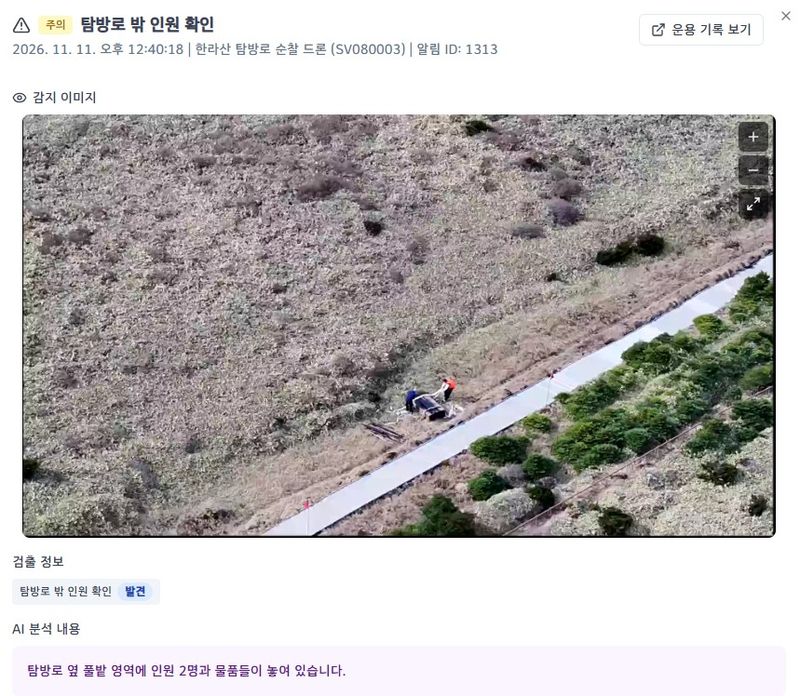
【Financial News, Jeju = Jeong Yong-bok】 An AI drone found a tourist who had strayed from a designated trail on Hallasan, leading to guidance at the scene. Jeju Province has completed a safety-management demonstration linking drone footage analysis and monitoring with on-site response, raising expectations of changes to patrol methods in mountainous areas.
According to Jeju Special Self-Governing Province on the 24th, a drone patrolling the area around Witse Oreum on Hallasan on the 8th spotted a foreign tourist who had left a designated trail and was taking photos in a nature conservation area.
The AI analyzed footage captured by the drone in real time and relayed signs of danger to the monitoring system. An official from Hallasan National Park then rechecked the situation on site and provided guidance. The case shows how a drone detected someone straying from a trail—a situation difficult for ground staff to identify on their own while patrolling a vast mountainous area—and enabled an actual on-site response.
The demonstration was carried out as part of the Ministry of Land, Infrastructure and Transport’s “Drone Demonstration City Development Project.” Jeju Province and the Hallasan National Park Management Office had discussed drone operations since last year and jointly pursued visitor safety management, monitoring of areas off designated trails, and communications infrastructure development this year.
Straying from Hallasan’s trails directly affects visitor safety and the protection of the natural environment. Leaving a designated trail can expose visitors to hazardous terrain, including steep slopes and rocky areas, and may damage vegetation in protected areas. The Natural Parks Act stipulates that access to certain areas may be restricted to protect ecosystems and ensure visitor safety, among other purposes.
Drone patrols can quickly check for these risks across wide areas. However, an unusual situation detected by AI is not automatically deemed a violation. As in this case, on-site verification by management staff and a subsequent assessment are necessary.
This year, Jeju Province conducted 101 safety patrols on four major trails, including Eorimok, Yeongsil, Gwaneumsa Temple, and Seongpanak. It also conducted 100 patrols to prevent accidents in off-trail risk areas such as Janggu-mok and Keun Durewat.
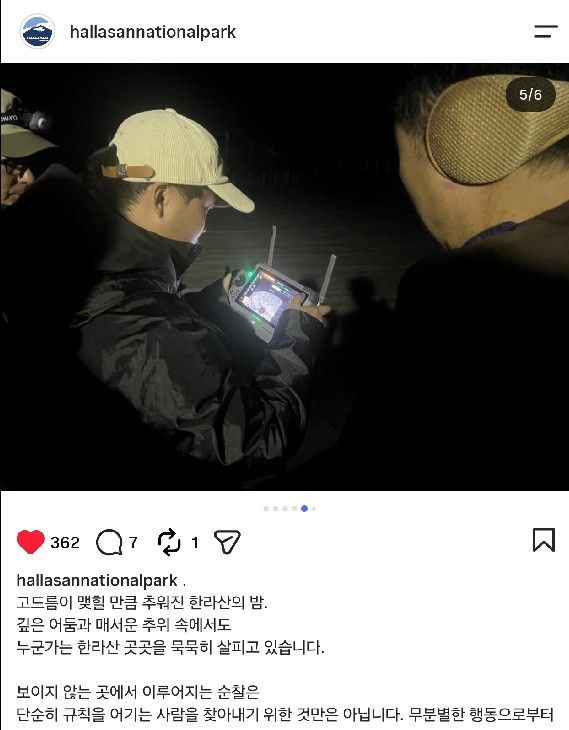
Communications-quality maps were also created for the airspace above four trails. The maps show how reliably communications connect depending on the drone’s altitude and location. Communications conditions can vary with the terrain in mountainous areas. Checking communications conditions for each flight zone is important to ensure stable video transmission, remote control, and connectivity with the monitoring system.
Based on the results of the demonstration, Jeju Province plans to expand public safety services that link unmanned drone operating bases, the provincial integrated drone control center, and an AI video analysis system. In particular, it plans to gradually expand automated remote dispatch, repeated patrols, and nighttime AI monitoring, focusing on the areas around Eorimok and Witse Oreum.
Jeju Province is expanding the use of drones beyond safety management in mountainous areas to include daily-life and medical services for island communities. Since 2023, it has been developing drone delivery services for outlying islands such as Gapado, Marado, and Biyangdo. This year, in partnership with the West Seogwipo Public Health Center, it tested the transport of medical supplies and the collection and transport of waste medicines.
Last July, emergency medicine was delivered by drone to Gapado after ferry services were suspended due to bad weather. The case demonstrated the potential for drones to provide public services in areas that are difficult to reach by land or have limited maritime transportation.
Jang Cheol-won, director general of Jeju Province’s Future Industry Bureau, said, “This achievement confirms that drone and artificial intelligence technologies can be put to practical use in visitor safety management and the protection of the natural environment,” adding, “We will continue to develop them into public services that residents and tourists can experience firsthand.”
[email protected] Jeong Yong-bok Reporter