Move to Impose Up to Five Years in Prison for Cheating on National Qualification Exams
- Input
- 2026-11-24 15:34:34
- Updated
- 2026-11-24 15:34:34
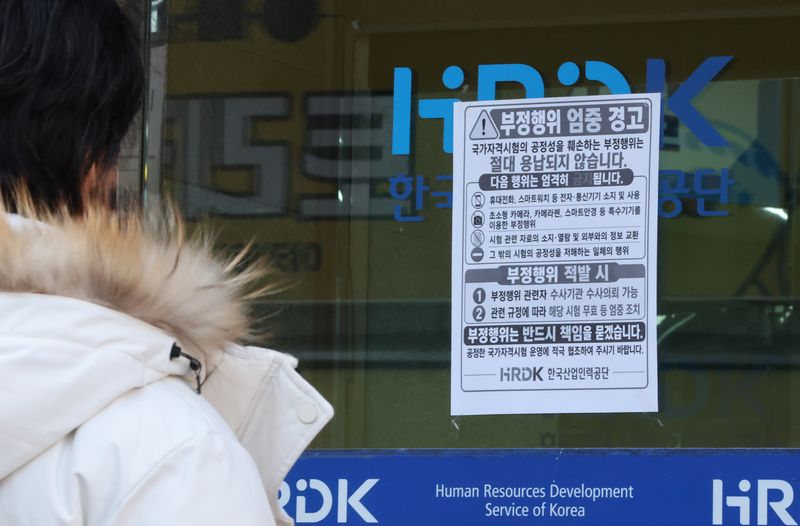
Under the measures to ensure fairness in national qualification exams reported by the Ministry of Employment and Labor and the Human Resources Development Service of Korea at a Cabinet meeting on the 24th, the government plans to extend the period during which people caught cheating are barred from taking exams to 10 years and increase criminal penalties to up to five years in prison. The aim is to strengthen the current three-year exam ban and maximum two-year prison sentence to punish and deter cheating more severely.
The government plans to establish uniform standards for exam-ban periods for professional qualifications administered by different agencies, in consultation with the relevant ministries, and to introduce new criminal penalty provisions. It will also establish a reward system for reporting cheating to encourage more reports.
The government also plans to improve exam formats. The proposed measures include diversifying formats, such as practical and interview-based exams, merging or abolishing unnecessary qualification exams, and introducing a system to certify work experience.
The government will also work to improve the proctor pool and infrastructure by securing funding. Measures include assigning more proctors dedicated to smart devices and expanding their training and practical exercises; introducing detection devices, such as radio-wave and non-linear junction detectors; expanding dedicated test centers; and equipping rented test venues with portable CCTV systems and proctor body cams (wearable cameras).
The policy on disclosing scores will also be revised to address doubts about exam results as much as possible. The government plans to disclose the scores of the top two candidates who pass, the average score of all examinees, and score distributions by subject.
For measures being implemented immediately, procedures to prevent, detect, and track cheating have been established for the stages before, during, and after exams. They have already been applied, starting with the Security Instructor exam held on the 21st, which had 11,554 candidates. A total of six instances of cheating were detected in that exam, including possession of tablet PCs or smartwatches and failure to turn off mobile phones.
Before exams, proctors will personally check whether electronic devices have been turned off and will randomly call examinees before each subject exam begins to check again. The government also plans to strengthen notices that cheating can result in criminal penalties and to provide more training for proctors.
During exams, candidates will be required to wear nonwoven-fabric coverings to prevent recording with miniature cameras. More proctors will be assigned, and smart applications (apps) that detect Bluetooth signals will also be used. To detect cheating after exams, the government plans to use follow-up tracking measures, including comprehensive investigations and receiving tips, and to refer cases for investigation when necessary.
A Ministry of Employment and Labor official said, “Under the principle of ‘thoroughly preparing to guard against cheating and pursuing crimes to the end,’ we will focus our efforts on restoring the credibility and fairness of national qualification exams.” The official added that the ministry plans to prepare detailed implementation measures by the end of the year through a “Task Force for a Comprehensive Review of the National Qualification System and Development of Measures,” headed by the vice minister.
[email protected] Kim Jun-hyeok Reporter