Lee Administration Seeks to Restore Western Trust... Security Infighting, Trade Caution Toward U.S. and EU
- Input
- 2026-11-24 16:08:55
- Updated
- 2026-11-24 17:46:33

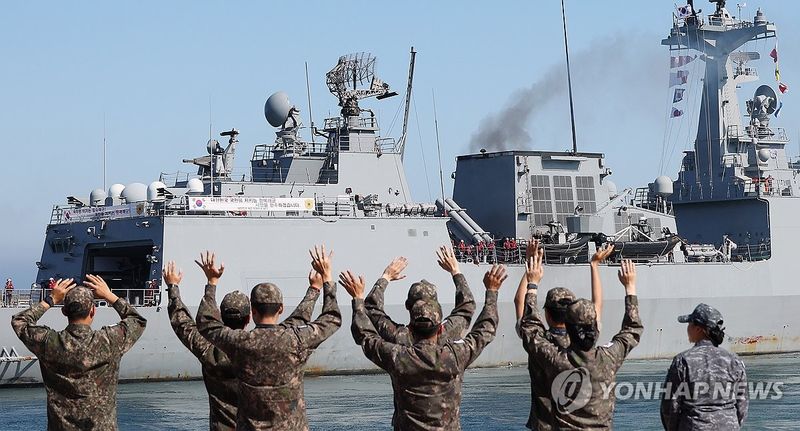
On the 24th, the National Assembly’s National Defense Committee held a subcommittee meeting to review a revised motion to extend the Cheonghae Unit’s deployment. With the ruling and opposition parties reaching a consensus on expanding its operations, passage of the motion has become all but certain. However, final action was delayed by a day as the parties coordinated a supplementary opinion sought by the Democratic Party to address concerns in the broader progressive camp about involvement in war. The motion’s main provisions are to expand the unit’s operational area from its current location around the Gulf of Aden off Somalia to international waters south of Oman, and to add a mission supporting the restoration of freedom of navigation. This would broaden the mission beyond combating piracy and protecting Korean vessels to ensuring the security of international sea lanes. It also carries considerable foreign and security policy significance, as it would lay the groundwork for expanding maritime security cooperation with allies and friendly countries around the Strait of Hormuz in an emergency.
The Finance and Economy Planning Committee also held a tax subcommittee meeting on the matter today, following one the previous day, but discussions on an automotive production tax credit remained unresolved for a second day as the possibility of opposition from the United States and the EU emerged as a major obstacle. The ruling and opposition parties agree that support for EV production is needed, given that the erosion of the domestic market by Chinese-made electric vehicles could threaten supply chains for key components in future industries. However, they are taking more time to consider whether to limit tax benefits to vehicles sold domestically or extend them to exports as well. With the government set to announce details this week, a Democratic Party lawmaker on the committee told this newspaper today that it would be difficult to reach a decision that day because the issue is sensitive amid concerns about trade friction with the United States and the EU.
A clearer foreign policy line has run up against a complex equation of domestic and international interests.
During the Hormuz crisis earlier this year, the United Kingdom, France, Japan and Canada quickly mounted a joint response based on their existing cooperative relationships, while South Korea joined a joint statement only later. Controversy over the country’s foreign policy grew after President Lee appointed Democratic Party lawmaker Song Young-gil, who had served as a special envoy to Russia, as a special presidential adviser for peace diplomacy last month, and then emphasized the need to manage relations with Russia to develop the Northern Sea Route (NSR), saying, “There are no eternal enemies, nor eternal allies.” The South Korean government stated that it would abide by international sanctions against Russia, but concerns were raised in European diplomatic circles. More recently, strains in South Korea-U.S. relations have continued, including difficulties faced by ruling-party figures in obtaining U.S. visas, controversy over South Korea being left out of South Korea-U.S.-Japan intelligence cooperation, and the postponement of the Security Consultative Meeting (SCM).
Meanwhile, the previous day, President Lee replaced not only the foreign minister but also Unification Minister Chung Dong-young, who has prioritized improving inter-Korean relations, and National Intelligence Service Director Lee Jong-seok. He selected Lim Woong-soon, second deputy director of the National Security Office, as his nominee for foreign minister; Lim has experience in both diplomacy with the United States and negotiations on North Korea’s nuclear program. The first defense white paper of the Lee Jae-myung administration, which had prompted disagreement between the defense and unification ministries, is also expected to retain the existing language describing the North Korean regime and military as enemies. Together with moves to expand the Cheonghae Unit’s operations, this points to an effort to clarify the country’s foreign and security policy around the South Korea-U.S. alliance.
However, the ruling party and government also face a growing political burden as they seek to manage opposition from the broader progressive camp. Controversy over an indirect deployment has emerged not only in the Rebuilding Korea Party and the Progressive Party but also within the Democratic Party. Democratic Party lawmaker Kim Yong-min said in a social media post the previous day, “This change to the operational area could certainly be suspected of being an indirect deployment,” and argued, “We cannot send our troops into a war without justification.” Kim’s point was that an expansion of the operational area would put the Cheonghae Unit within range of Iranian missiles.
Amid this opposition, Democratic Party lawmaker Kim Byung-joo, the president’s special adviser on defense policy, proposed including the principle of non-involvement in war in a supplementary opinion, and Defense Minister Kang Shin-chul also supported the idea. According to People Power Party lawmaker Lim Jong-deuk, the opposition secretary on the National Defense Committee, the Democratic Party initially drew up a detailed supplementary opinion to head off controversy over involvement in war and “a backdoor deployment.” However, amid concerns that it could unduly restrict the Cheonghae Unit’s operations, the ruling and opposition parties narrowed it down to two points. They plan to hold a subcommittee meeting at 10 a.m. on the 25th and prioritize processing the motion once they agree on the final wording.
In trade, the fact that security allies are also industrial competitors is deepening the ruling party and government’s concerns. The United States and the EU share with South Korea an economic security interest in reducing reliance on supply chains linked to China, but compete over attracting production facilities, investment and jobs. If tax benefits are extended to exports of EVs made in South Korea, Korean companies could become more price-competitive in overseas markets. The United States and the EU, which are focused on protecting their domestic manufacturing industries, could therefore raise concerns about subsidies or take trade measures such as imposing countervailing duties.
As the Lee Jae-myung administration strengthens security cooperation with the West, it must ease opposition from its existing support base and protect domestic production against China’s industrial offensive, while also managing trade friction with its security allies. Its pragmatic diplomacy, centered on the national interest, has thus entered a full-fledged test.
[email protected] Jiwon Song Reporter