“Up 31%, Is It Right to Buy?”...Retail Investors Get Excited Over Jensen Huang’s Return: “But Why Are Price Targets Falling?” [The World of Retail Investors]
- Input
- 2026-11-24 16:35:10
- Updated
- 2026-11-24 16:35:10
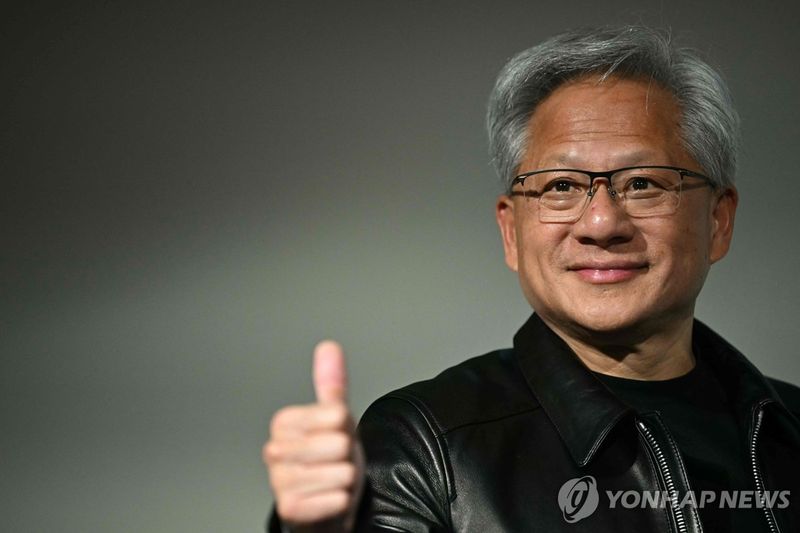
[Financial News] “I sold off my NVIDIA shares when I heard Jensen Huang was stepping down, but they jumped 31% in a single day as soon as news of his return broke. I’m wondering whether I should buy back in even now.”Office worker A found himself in a dilemma after checking news about the U.S. stock market during his commute on the morning of the 24th. The New York stock market had surged overnight after Jensen Huang, NVIDIA’s chief executive officer (CEO), who stepped down on the 12th over an affair scandal, returned just 11 days after his resignation.
The return of the founder who led NVIDIA for 33 years left A torn over whether to buy the stock again. “They say that if NVIDIA rebounds, Samsung Electronics and SK hynix will rise too, but I’m worried because there are constantly reports that securities firms are lowering their target prices,” A said.
Returns 11 days after resignation... NVIDIA up 31.5%, its biggest gain in 23 years
NVIDIA’s board of directors unanimously approved a motion on the 23rd (local time) to reinstate Jensen Huang as CEO. The board said it had determined that Huang’s return as CEO would not pose a threat to national security. On the day his reinstatement was announced, Huang went to work at NVIDIA’s headquarters in Santa Clara, California, in the United States.
On the day news of Huang’s return became known, NVIDIA surged 31.48% to close at $165.05, taking its market capitalization above $4 trillion. It was the biggest one-day gain in about 23 years, since May 2003. All three major New York stock indexes also ended higher. The S&P 500 rose 4.73%, the Dow Jones Industrial Average (DJIA) gained 3.01%, and the NASDAQ Composite Index climbed 6.51%.
AI-related stocks including Micron (19.04%), CoreWeave (22.32%) and Oracle (12.34%) surged, and the PHLX Semiconductor Sector Index (SOX) also rose 14.03%, lifting the South Korean market. On the 24th, the KOSPI closed at 5,006.03, up 6.32% from the previous day, reclaiming the 5,000 level. Samsung Electronics and SK hynix also ended the session up 6.70% and 6.73%, respectively, at KRW 189,400 and KRW 1,158,000.
Target prices are falling... but the gap is widening instead
Expectations of a rebound are growing among individual investors who have recently been battered by a sharp market slump. However, they are hesitating to buy more because securities firms continue to lower their target prices. Analysts have been cutting their targets for Samsung Electronics and SK hynix, citing a slowdown in the memory market, supply competition from China and uncertainty over AI investment.
Global investment bank Morgan Stanley lowered its target price, expecting memory profit margins to return to their historical average after 2029. Goldman Sachs also cut its target prices for both stocks. They maintained their investment ratings at “overweight” and “buy,” respectively.
There is also reason not to treat a target-price cut as an immediate sell signal. Stock prices have fallen faster than analysts have lowered their targets, causing the gap between average target prices and actual share prices to widen instead. As of last week, the gap had widened to 138% for Samsung Electronics and 173% for SK hynix.
Huang has returned, but... “Investigations and export issues remain”: a cautious view
Some caution that it is too early to view Huang’s return as unambiguously positive. Dan Ives of U.S. investment firm Yorkville Ives noted in a client report that day: “An independent committee investigation is underway, as is a government investigation that the company has said it is cooperating with, and the export issues have not been resolved.”
Han Ji-young, an analyst at KIWOOM Securities, said Huang’s return “appears to have eased anxiety over the continuity of the AI ecosystem, going beyond simply mitigating owner-related risk.” However, she added, “Independent and government investigations into Huang are scheduled to continue until early next month, and there is potential for noise to emerge in the process.”
Han added, “It is difficult to say that the fundamental concerns that have driven the market correction since last month have been fully resolved, including uncertainty over AI companies’ investment profitability and free cash flow (FCF), uncertainty about the Democratic Party’s data center regulations, and concerns about a memory downcycle. Since market jitters have not yet fully dissipated, investors need to be prepared for the possibility of greater volatility ahead.”
Meanwhile, Huang is scheduled to appear at a closed-door inquiry by the U.S. House of Representatives on the 1st of next month and a public hearing before the Senate on the 3rd. The outcome of the hearing and whether uncertainties, including those surrounding export controls, are resolved are expected to affect the share prices of related companies, including NVIDIA, Samsung Electronics and SK hynix.
[email protected] Kim Hee-sun Reporter