The Global Food Market Enters the $10 Trillion Era... Localization and Distribution Networks Are Key to K-food Growth
- Input
- 2026-11-26 08:22:36
- Updated
- 2026-11-26 08:22:36
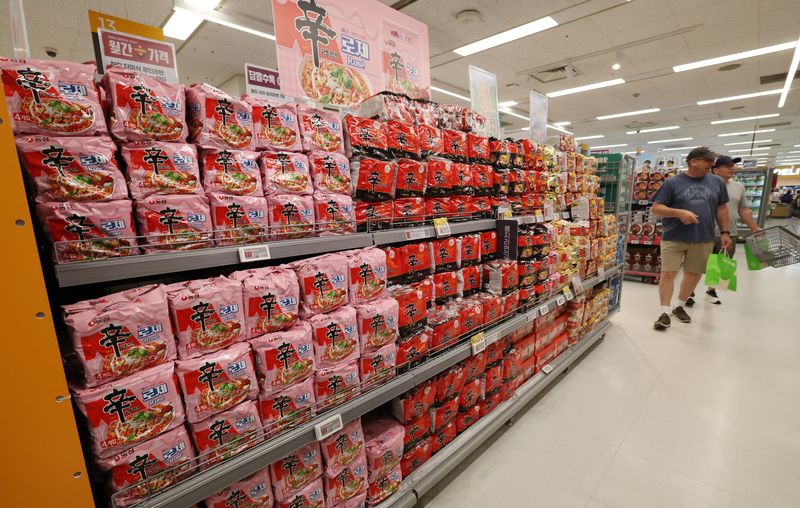
[Financial News] The global food market is expected to grow to a record $10 trillion next year. One strategy proposed to establish K-food successfully is to turn one-time purchases into repeat consumption by developing local products tailored to tastes around the world and expanding distribution networks.
According to the Korea Agro-Fisheries & Food Trade Corporation (aT)’s “2027 Global Agro-Food Market and Export Outlook Report,” obtained by this newspaper on the 26th, the global agro-food market is projected to reach $10.2606 trillion next year. That would be an increase of about 6.0% from this year’s estimate of $9.675 trillion.
As the global food market enters the $10 trillion era, competition among food companies worldwide to gain an early foothold in the market is expected to intensify further.
The global food market’s growth is also expected to continue over the medium to long term. It is projected to grow at an average annual rate of 6.2% from this year onward, reaching $12.2929 trillion by 2030.
However, an expanding market does not necessarily translate directly into increased exports by domestic food companies. Observers say differentiated strategies tailored to consumer trends are needed as global consumers’ criteria for food purchases change.
The report therefore analyzed that, in the global market next year, strategies to move beyond interest in K-food and establish individual products as part of everyday consumption in export markets will become important.
The report said, “We must clearly communicate Korean flavors and what sets them apart, and make K-food more useful in local diets and easier to buy, turning interest in K-food into repeat purchases and stable exports.”
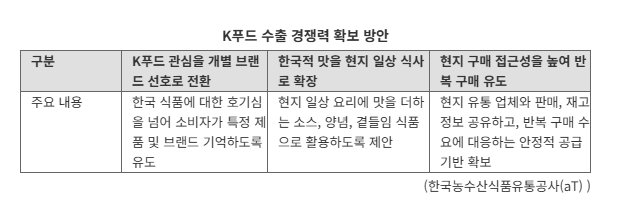
To that end, it proposed three strategies: turning interest in K-food into preference for individual brands, incorporating Korean flavors into everyday local meals, and encouraging repeat purchases by making products easier to buy locally.
To first turn interest into preference for individual brands, it stressed that “while leveraging awareness and preference for K-food, we must clearly present the strengths and distinctive qualities that set it apart from competing products,” and that “the information conveyed at consumer touchpoints—such as packaging, product information, samples and promotional content—as well as product features and points of differentiation must be consistent.”
The report also considered it important to incorporate Korean flavors into everyday local meals. It recommended easing barriers to purchase by offering ways to use the products with familiar local ingredients and dishes, along with simple recipes.
The report also stressed the need to encourage repeat purchases by making products easier to buy locally. It said distribution channels should expand from sales focused on Korean and Asian outlets to local supermarkets and online stores, making it possible for local consumers to buy K-food as part of their everyday grocery shopping.
An aT official said, “An important factor in product choice is expected to be not only affordability but also how satisfactorily consumers can consume food within a set food budget.” The official added, “Rather than focusing solely on pricing strategies such as temporary discounts, companies will need an approach that supports consumers’ varied choices and contributes to a better dining experience.”
[email protected] Kim Seo-yeon Reporter