Hyundai Motor Group’s European ‘No. 4’ Spot Wavers... Gap With BMW Narrows to 20,000
- Input
- 2026-11-25 07:29:00
- Updated
- 2026-11-25 07:29:04

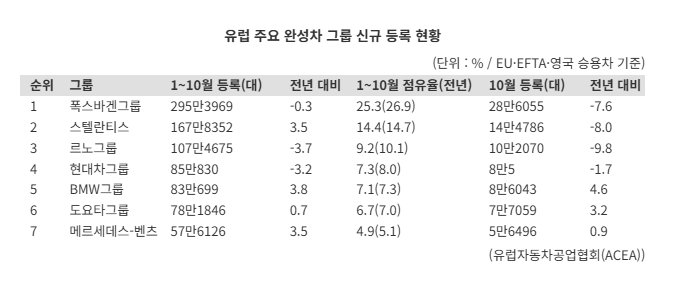
According to the European Automobile Manufacturers’ Association (ACEA) on the 25th, Hyundai Motor Group registered 850,830 new passenger cars in Europe (the EU, EFTA and the United Kingdom) from January to October this year, down 3.2% from the same period a year earlier. It ranked fourth, behind Volkswagen Group (2,953,969), Stellantis (1,678,352) and Renault Group (1,074,675). The European market as a whole grew 6.0% over the same period, while Hyundai Motor Group contracted 3.2%. By contrast, BMW Group registrations rose 3.8% to 830,699, and Toyota Group registrations increased 0.7% to 781,846.
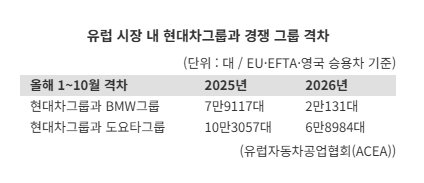
As a result, the gap between Hyundai Motor Group and BMW Group narrowed from 79,117 vehicles in January–October last year to 20,131 this year. The gap with Toyota Group also shrank, from 103,057 to 68,984. Hyundai Motor Group’s market share fell from 8.0% to 7.3%, while its lead over BMW Group, whose share was 7.1%, narrowed from 0.7 percentage points to 0.2 percentage points.
The monthly ranking has already been reversed. In October, BMW Group registrations rose 4.6% to 86,043, while Hyundai Motor Group registrations fell 1.7% to 80,005, leaving Hyundai Motor Group behind by 6,038 vehicles. According to ACEA’s monthly figures, this was the second time this year that BMW Group had outpaced Hyundai Motor Group, following June.
Performance varied by brand within the groups. Kia Corporation registered 468,627 vehicles from January to October, up 7.4%, while Hyundai registered 382,203, down 13.7%. Hyundai’s October registrations fell 18.8% to 33,245. Within BMW Group, BMW brand registrations rose 1.6% to 672,258, while Mini stood out with 14.3% growth to 158,442.
Weakness in Europe stands in sharp contrast to strong performance in the U.S. Hyundai and Kia sold 160,083 vehicles in the U.S. in October, including GENESIS, up 9.5% from the same month last year and a record for October. Hyundai’s sales as a standalone brand also rose 5% to 73,452, while cumulative sales from January to October increased 3% to 770,916.
Investment is also being concentrated in the U.S. Late last month, Hyundai announced plans to invest about $450 million in its Alabama plant to support production of future vehicles and expand its engine-manufacturing capabilities. The investment is part of Hyundai Motor Group’s $26 billion investment in the United States through 2028.
Meanwhile, the European market is changing rapidly. Electric vehicles accounted for 23.4% of new EU passenger-car registrations from January to October, up 7.0 percentage points from 16.4% a year earlier. Chinese automakers are also making strong gains. Over the same period in Europe (the EU, EFTA and the United Kingdom), BYD registrations rose 132.7% to 322,818, while Chery Group registrations increased 240.2% to 295,969.
An industry insider said, “While efforts are focused on responding to U.S. tariffs and expanding local production, the rollout of new models and pricing responses in Europe have been relatively slow,” adding, “With Chinese companies rapidly gaining ground in the market, it is time to reassess the strategy for Europe.”
[email protected] Kim Dong-chan Reporter