“Even if Hired, They Don’t Last Three Years”...SME R&D Workforce Down 13% in Four Years
- Input
- 2026-11-24 14:38:51
- Updated
- 2026-11-24 14:38:51
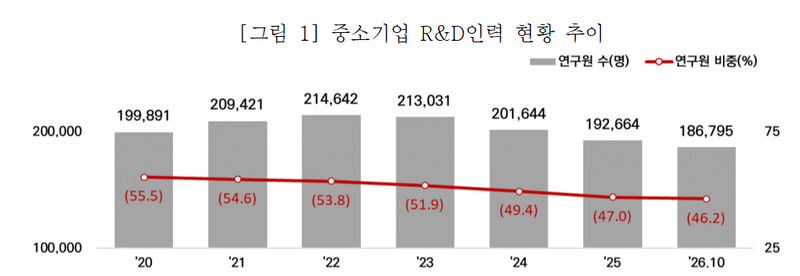
A report published on the 24th by the Korea Small Business Institute (KOSBI), titled “The Crisis and Opportunity for SME R&D Personnel in the AI Transition,” found that SMEs had 186,795 R&D personnel registered with corporate-affiliated research institutes as of October. That was a 13% decline (27,847 people) in four years, from 214,642 in 2022.
By contrast, over the same period, R&D personnel at mid-sized companies increased by 29.3% (14,793 people), while those at large corporations rose by 14% (18,682 people). SMEs’ share of all corporate R&D personnel also fell by 7.6 percentage points, from 53.8% in 2022 to 46.2% this October. The gap in securing R&D personnel is widening by company size.
SMEs also lagged behind large corporations in securing highly qualified researchers. Master’s and doctoral degree holders made up 25.4% of SME R&D personnel, 16.4 percentage points below the 41.8% share at large corporations. The share of personnel aged 50 or older rose by 7.6 percentage points, from 13.4% in 2020 to 21.0% last year. Analysts say that the existing workforce is aging as new personnel are not entering the field smoothly.
SMEs are also struggling to secure the specialists needed for the AI transition. A survey of 283 SMEs with at least five employees and corporate-affiliated research institutes found that 45.6% of companies conducting R&D said they needed to hire AI specialists but could not afford labor costs and other expenses. Only 9.5% said they could afford to hire AI specialists but did not need them. In other words, while the need to adopt AI is growing, investment in the personnel needed to support it remains limited.
It was also difficult to retain staff hired after considerable effort for an extended period. Only 27.2% of companies said newly hired R&D personnel stayed for three years or more. The largest share, 30.0%, said they stayed for at least one year but less than two; 24.4% said at least two years but less than three, and 18.4% said less than one year.
Staff departures also caused significant harm to business operations. Among SMEs conducting R&D, 20.1% said they had experienced adverse business impacts when R&D personnel changed jobs in the past three years. By industry, the share reporting such impacts was 10.3 percentage points higher in manufacturing (23.7%) than in non-manufacturing (13.4%). Innovation-oriented SMEs (21.3%) also experienced more harm from staff departures than ordinary SMEs (15.5%).
The government support companies said they needed most was hiring subsidies. Of the companies surveyed, 58.7% cited hiring subsidies as necessary to make use of R&D personnel. This was followed by tax support for R&D and human resource development expenses (12.4%), support for the costs of using AI (11.3%), and support connecting workers with jobs at SMEs (8.1%).
Min-seon Noh, a research fellow at KOSBI, emphasized, “The decline in SME R&D personnel and frequent job changes could weaken technological innovation capabilities,” and, “The AI transition should be used as an opportunity for SMEs to overcome labor shortages and improve productivity.”
[email protected] Lee Ju-mi Reporter