Justice Minister Nominee Lee Yong-cheol: “I Won’t Direct Indictment Withdrawals the Public Would Find Hard to Accept”
- Input
- 2026-11-24 14:19:41
- Updated
- 2026-11-24 14:19:41
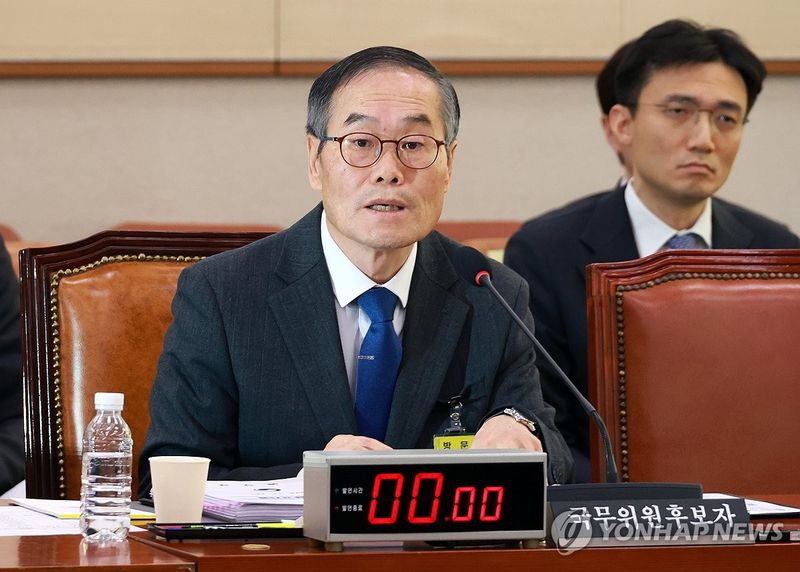
At a confirmation hearing held that day by the National Assembly’s Legislation and Judiciary Committee, the nominee was asked by Joo Jin-woo, a lawmaker from the People Power Party, whether he intended, as Minister of Justice, to direct the withdrawal of the indictment against President Lee. He replied, “I have no intention of exercising my authority in an unreasonable way that the public would find hard to accept.”
He added, “The purpose of this special counsel investigation is to establish the facts about whether there were illegal indictments resulting from the misuse or abuse of prosecutorial powers,” and said, “It is prosecutors, not me, who withdraw indictments.”
When Rep. Joo went on to ask whether indictments should not be withdrawn in cases where the special counsel investigation into fabricated indictments had uncovered no problems, the nominee replied, “If the facts are not clearly established, of course I will not withdraw the indictment.”
The nominee also agreed that human rights violations had occurred in the past as a result of the misuse and abuse of prosecutorial powers. When Kim Dong-ah, a lawmaker from the Democratic Party of Korea (DPK), asked whether unlawful investigations had been fabricated to eliminate political rivals under the Yoon Suk Yeol administration and whether they needed to be addressed, he said, “I agree that the misuse and abuse of prosecutorial powers led to many human rights violations.”
However, he drew a distinction, saying that an acquittal alone was not enough to establish that an indictment had been fabricated. When Park Jie-won, a DPK lawmaker, noted that he had received a final acquittal in the case involving the shooting of a South Korean official in the West Sea, in which Park had been indicted, the nominee said, “It is difficult to equate an acquittal alone with the indictment itself having been fabricated. However, if an important reason for the acquittal was unreasonable and unlawful conduct during the indictment process, that aspect should be dealt with strictly.”
He also noted the need for institutional measures to address the difficulties crime victims face in submitting evidence following the separation of investigation and indictment. Kim Nam-hee, a DPK lawmaker, asked whether the Criminal Procedure Act should be amended to allow prosecutors to use as evidence materials they had obtained to maintain a prosecution.
The nominee said prosecutors’ collection of evidence and submission of it to the court could be regarded as having an investigative character. He nevertheless replied, “A new system should not inconvenience the public, so, as long as the principle is not undermined, we need to look for sensible measures among the Public Prosecution Office, investigative agencies and the courts to resolve the issue.”
However, he maintained his opposition to giving prosecutors direct authority to conduct supplementary investigations. When Park Eun-jung, a lawmaker from the Rebuilding Korea Party, asked whether retaining that authority would mean maintaining prosecutors’ investigative powers, the nominee said, “I do not support supplementary investigations, and indictments and investigations should be separate.” He added that institutional measures were needed to make requests for supplementary investigations more effective and prompt.
Regarding allegations surrounding him in connection with the Daejang-dong Development Corruption Scandal, the nominee responded that he “did not know much about them” or, in effect, that he had not been involved.
Regarding his past conviction for violating the Labor Standards Act while serving as head of a foundation, he said, “I am deeply sorry,” explaining that the problem arose because he had failed to properly scrutinize customary practices. He also apologized, saying it was his fault that his spouse’s shareholdings exceeded the statutory limit, while maintaining that they had no connection to his official duties.
[email protected] Choi Eun-sol Reporter