Phase 2 of Digital Asset Law Moves Forward... Only Bank-Majority Consortia Can Issue Stablecoins
- Input
- 2026-11-24 15:00:00
- Updated
- 2026-11-24 15:28:31

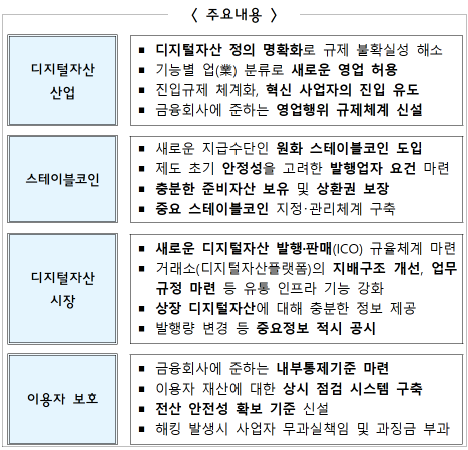
As interests clash between legacy finance, centered on banks, and the fintech industry, opposition parties set to take part in the legislation have made their opposition clear. Amid forecasts that payment and settlement markets using stablecoins could grow explosively in the era of AI agents, the government plans to foster digital industries while also achieving its goals of protecting consumers and strengthening the public interest.
On the 24th, Financial Services Commission Chairman Lee Eok-won convened the Virtual Asset Committee to discuss a draft bill for the Act on Innovation in the Digital Asset Industry and Protection of Users. The government defined stablecoins in law as “digital payment tokens.” Domestic issuers and redeemers of digital payment tokens will be required to obtain FSC authorization by meeting requirements including equity capital of at least 5 billion won. During the initial phase of the law’s implementation, only consortia in which the banking sector holds a majority stake will be permitted to issue them. Financial authorities explained that fintech and technology companies could also participate as the largest shareholder, depending on the consortium’s ownership structure. For example, a fintech company could take the lead in issuing tokens if it secured the remaining shares in a consortium where Banks A, B, C, D and E each held a 10.1% stake.
Issuers must obtain approval for their issuance plans and may not pay interest to holders. This makes clear that digital payment tokens are not deposits. They must also promptly meet redemption requests with money of equivalent value. To back this, reserve assets must be deposited with or held in trust by banks and other institutions in an amount equal to at least 100% of the outstanding issuance.
Yoo Young-jun, director general for digital finance policy at the FSC, said, “The types of reserve assets will be specified in detail in an enforcement decree,” adding, “We are not considering banks as the only institutions to manage reserve assets; other institutions may also serve, but this too will be stipulated in the enforcement decree.”
Given the nature of stablecoins, issuers can earn revenue only by managing reserve assets or through payment and settlement fees. If all reserve assets had to be held at banks, it would be difficult for issuers to earn high returns. Overseas, issuers generate returns by investing part of their reserve assets in government bonds and other assets, but the government’s bill does not specify what proportion may be invested this way in Korea.
A banking industry official said, “It is encouraging just that the bill has been made public. It is unclear how much stablecoins will actually be able to replace credit cards, but each bank has made thorough preparations based on various scenarios.” The official added, “The payment and settlement market using AI agents could actually balloon in an instant, so the bill must quickly pass through the National Assembly to prevent overseas coin platforms from being the only ones making money.”
A digital asset industry official said, “Banks are also entering the blockchain space, but it is unclear whether they would really welcome this business. If stablecoins are institutionalized, remittance fees could fall by as much as 80%, reducing banks’ revenue.” The official continued, “For banks to maintain their existing remittance-fee revenue, the stablecoin market would have to grow by that much,” adding, “Banks will see the stablecoin business as a threat to their own turf, so it is concerning that only bank-led consortia will be allowed to issue them.”
[email protected] Park Moon-soo Reporter