Korean Air Steps Up UAV Technology, From Reconnaissance to Formation Flight
- Input
- 2026-11-25 18:06:00
- Updated
- 2026-11-25 18:06:00
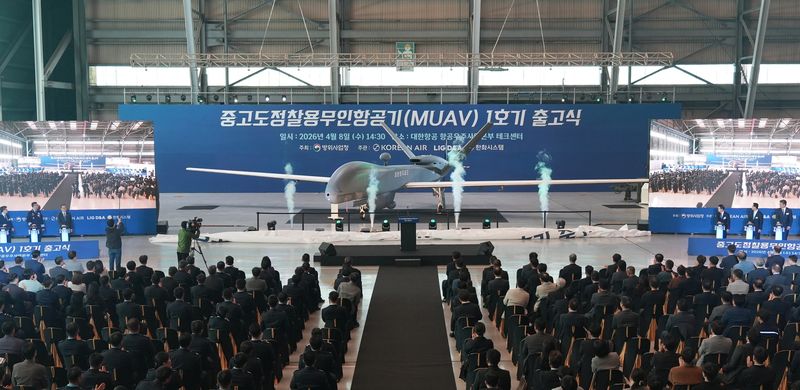
[Financial News] Korean Air is contributing to strengthening the combat capabilities of the South Korean military and securing global competitiveness for the K-defense industry by participating in the mass production of the Medium Altitude Unmanned Aerial Vehicle (MUAV), the country’s first strategic-class unmanned aircraft.
The first mass-produced MUAV, unveiled by Korean Air on April 8 at its Tech Center in Gangseo-gu, Busan, is 13 meters long and 26 meters wide and is equipped with a powerful 1,200-horsepower turboprop engine. It can fly at altitudes of at least 10 kilometers and conduct reconnaissance on targets on the ground.
Korean Air was responsible for the system development of the first mass-produced MUAV, once again demonstrating its unrivaled capabilities in UAV systems integration. In particular, it combined numerous subsystems—including the ground control system, data links, state-of-the-art detection sensors and avionics equipment—into a single, organic whole, establishing an efficient integrated operating system.
The MUAV is scheduled to be delivered to the Air Force early next year and deployed on full-scale operational surveillance and reconnaissance missions. Once deployed, it is expected to enable faster operational command by providing real-time imagery of enemy strategic targets.
Korean Air is also developing low-observable unmanned formation aircraft through a project for the Agency for Defense Development (ADD). It is also developing technologies for the combined operation of manned and unmanned aircraft. The company aims to unveil the country’s first manned-unmanned fighter aircraft teaming system in 2027. In addition to aircraft development, it is building technological capabilities in areas critical to UAV operations, including autonomous swarm flight for AI-based manned-unmanned and unmanned-unmanned teaming systems, low-observable technology, control technology for tailless aircraft, and hybrid engine technology. These are considered essential technologies for future UAV development.
Korean Air is also actively working to advance the domestic UAV industry, including by providing a forum for exchanges among industry, academia, research institutions and government. It holds an annual UAV core technology exchange forum, where it discusses the current state and future direction of the domestic UAV industry with relevant research institutions and industry representatives. Last year, presentations and open discussions covered the status and direction of development of low-observable unmanned formation aircraft for manned-unmanned teaming systems, the status of domestic technology development for mission autonomy, and trends in the development of structural technologies for low-observable UAVs.
[email protected] Jung Won-il Reporter