“I’ll Buy My Own Home Rather Than Rent on Jeonse in Seoul”... Shift Toward Nearby Capital Region Intensifies Amid Jeonse Crunch and Shift to Monthly Rent
- Input
- 2026-11-24 13:09:07
- Updated
- 2026-11-24 13:09:07
On the 24th, an analysis by real estate analytics firm Real Estate Info of the Ministry of Land, Infrastructure and Transport’s Real Estate Transaction Price Disclosure System found that the number of new jeonse contracts for Seoul apartments in the first half of this year fell 32.0% to 27,942 from 41,073 in the same period last year. By contrast, new monthly-rent contracts rose from 34,593 to 35,146, lifting the share of monthly rent among all new rental transactions by 10 percentage points, from 45.7% to 55.7%.
The main reason for the slump in jeonse transactions is an acute shortage of available listings. According to real estate big-data firm Asil, as of the end of March this year, the number of jeonse listings for Seoul apartments had fallen 44.2% to 15,779 from 28,274 a year earlier. As listings disappeared, prices rose more sharply: the Korea Real Estate Board’s jeonse price index for Seoul apartments climbed 4.39% in the first half of this year, about five times the 0.89% increase in the first half of last year.
The trend of people moving out of Seoul is also borne out by official statistics. According to the Ministry of Data and Statistics’ Internal Migration Statistics, Gyeonggi Province had a net population inflow of 33,399 from January to September this year, up 45.0% from the same period last year. In particular, 223,416 people moved from Seoul to Gyeonggi Province.
As more people seek alternative housing amid the jeonse crunch, newly launched residential developments in the capital region with direct links to Seoul’s major business districts are drawing attention.
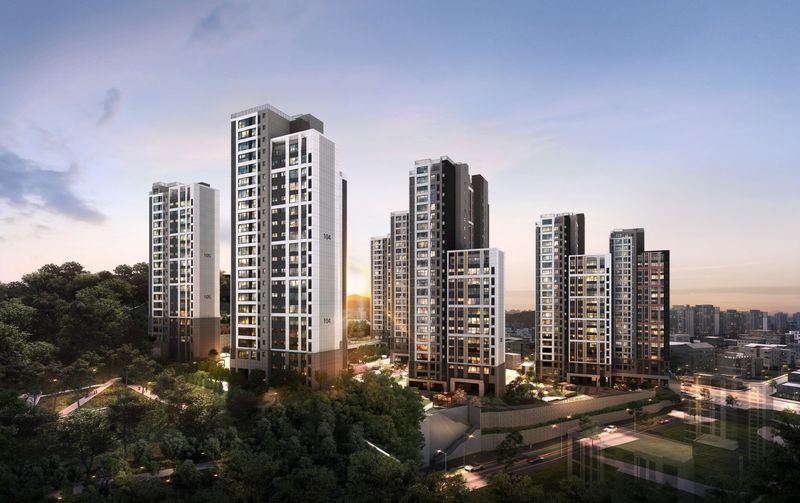
Daewon’s Gimpo Cantavil Edition, planned for Bukbyeon-dong, Gimpo City, Gyeonggi Province, is considered a leading development offering convenient access to workplaces in western Seoul and the prospect of a premium location near three stations. It will comprise nine buildings, with five basement levels and 24 above-ground floors, and 612 units with private-use areas of 66, 84, 104 and 127 square meters.
From Geolpo Bukbyeon Station on the Gimpo Goldline near the complex, Gimpo International Airport Station is about 16 minutes away and Magongnaru Station about 24 minutes. At Gimpo International Airport Station, passengers can transfer to Seoul Subway Lines 5 and 9 and the Airport Railroad to quickly reach key Seoul business districts such as Magok, Yeouido and Gangnam. In particular, the Seoul Subway Line 5 extension to Gimpo passed a preliminary feasibility study this year, bringing the expansion of direct transit links to Seoul into clearer view. With a future extension of Incheon Subway Line 2 to Goyang and the proposed GTX-D line also in the works, a premium for the area’s access to three stations is expected.
[email protected] Jeon Min-kyung Reporter