Huang's Return Quells 'AI Bubble' Fears... Stocks Soar as Panic Gives Way in a Day
- Input
- 2026-11-24 11:40:12
- Updated
- 2026-11-24 11:40:12

[Financial News] News of Nvidia CEO Jensen Huang’s return sent U.S. stocks sharply higher, followed by a powerful rebound in South Korea’s stock market.
Investor sentiment, which had been dampened by recent skepticism about AI investment and a sharp plunge in semiconductor stocks, recovered quickly, drawing buying into large-cap chipmakers such as Samsung Electronics and SK hynix. Foreign investors, who had been selling heavily, also turned to net buying, supporting the rise in the indexes.
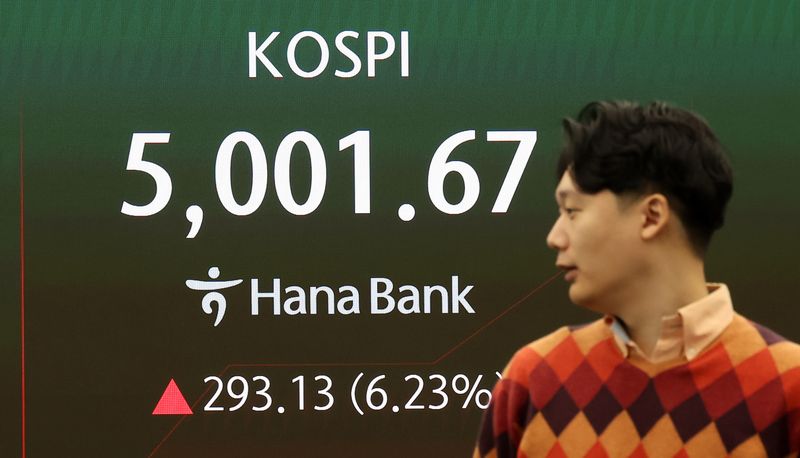
According to the Korea Exchange, as of 11:31 a.m. on the 24th, the KOSPI was up 322.32 points (6.85%) from the previous trading day at 5,030.86. The KOSDAQ also rose 33.30 points (5.24%) to 668.75. The KOSPI recovered the 5,000 level intraday, quickly recouping its recent steep losses.
Top stocks by market capitalization rose across the board. Samsung Electronics traded up 8.00% at 191,700 won, while SK hynix gained 8.94% to 182,000 won. Semiconductor and related value-chain stocks also climbed sharply, including Samsung Electronics preferred shares (7.45%), SK Square (8.38%) and Samsung Electro-Mechanics (11.70%). Buying also spread to other large-cap stocks, including Samsung SDI (11.62%), Hyundai Mobis (12.44%), Doosan Enerbility (6.68%) and Kia (7.52%).
The supply-and-demand picture also shifted. As of 11:31 a.m., foreign investors had net-bought about 949 billion won on the main board. Institutions also net-bought 323.2 billion won. Individual investors, by contrast, were net sellers of 1.4475 trillion won, apparently taking profits. This was the opposite of the recent steep downturn, when foreign investors sold large amounts of South Korean stocks.
The immediate catalyst for the rebound was CEO Jensen Huang’s return. On the 23rd (local time), Nvidia’s board unanimously decided to reinstate Huang immediately as president and CEO and a director. It came 11 days after his resignation was accepted on the 11th.
The board said it had heard from senior U.S. government officials and determined that Huang’s return would not pose a national security risk.
U.S. markets reacted immediately. On the 23rd, Nvidia surged 31.48% in the New York stock market, while the PHLX Semiconductor Sector Index (SOX) jumped 14.03%. The Nasdaq and S&P 500 indexes also rose 6.51% and 4.73%, respectively. Gains spread across the AI value chain, including Micron (19.0%), Dell (20.5%) and CoreWeave (22.3%).
Daishin Securities attributed the recent sharp decline not to slowing earnings in the AI industry but to eroding market confidence. In a report that day, Daishin Securities researcher Lee Kyung-min said, “The essence of the decline is not earnings but trust.”
The analysis was that Nvidia’s earnings and future profit outlook remained solid, but its stock plunged as a leadership vacuum and uncertainty over investment and supply commitments in the AI ecosystem grew.
According to Daishin Securities, Nvidia’s revenue for the third quarter of fiscal 2027 was $115.8 billion, 6.0% above market expectations, while its revenue forecast for the following quarter was also $130 billion, 3.8% above consensus. The explanation was that the stock plunged over the same period not because the earnings outlook had deteriorated but because its price-to-earnings ratio (PER) fell sharply. Lee said, “It wasn’t earnings that collapsed, but the degree of confidence in earnings.”
Daishin Securities sees a similar situation in South Korea’s semiconductor sector. Lee noted that the KOSPI’s 12-month forward earnings per share (EPS) had risen 35.2% since its peak last June, while the index had fallen 48.3%.
With companies’ earnings outlooks actually improving even as share prices fell sharply, valuation discounts had a greater effect than deteriorating earnings, the report said.
Lee said, “The basic framework of the strategy has not changed,” and maintained a staggered buying strategy focused on large-cap semiconductor stocks. He said the scope for buying could be broadened to IT hardware and oversold sectors with upgraded earnings outlooks if the KOSPI recovered the 4,911 level and foreign investors’ shift to net buying was confirmed. He added, however, that the surge may also have included technical buying, such as short covering and the unwinding of hedge positions, so the rebound’s staying power should be assessed.
[email protected] Kang Jung-mo Reporter