Ho Chi Minh City Unveils 100-Year Master Plan... “Five-Hub Strategy to Become a Global Megacity”
- Input
- 2026-11-24 13:27:21
- Updated
- 2026-11-24 13:27:21
[Hanoi, Vietnam — Correspondent Kim Jun-seok] Ho Chi Minh City, Vietnam's largest economic hub, has officially unveiled a master plan containing its medium- and long-term development strategy through 2050 and a vision for the next 100 years, declaring a major transformation into a global megacity.
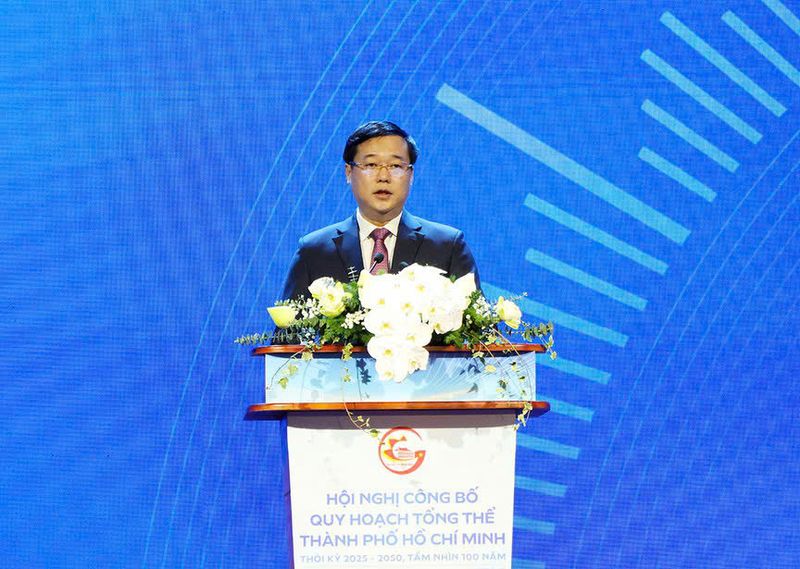
According to local media reports and other sources on the 24th, the Ho Chi Minh City People's Committee held an official presentation meeting for the “Ho Chi Minh City Comprehensive Plan for 2025–2050 and 100-Year Vision” the previous day at the Ho Chi Minh City Urban Planning Exhibition Center.
In his opening remarks, Lê Quốc Phong, chairman of the city's People's Committee, stressed, “The presentation of this comprehensive plan is a major milestone that opens a new development trajectory for Ho Chi Minh City.” He added, “We will establish a new growth model based on science and technology, the digital economy, the green economy, the circular economy, and the marine economy, while reshaping urban space around a human-centered philosophy into five growth-engine hubs, five satellite cities, 10 strategic linkage systems, and 10 development-management zones.”
Specifically, the five growth-engine hubs are divided into a core international finance and services hub in the downtown area; an innovation and creativity hub in the east; an industry and logistics hub in the north; a port, free-trade, and energy-industry hub in the south; and a residential, education, and medical hub in the west. The five satellite centers supporting these hubs are designated as Côn Đảo; Vũng Tàu–Long Hải–Hồ Tràm; Hóc Môn–Củ Chi; Bàu Bàng; and Bắc Tân Uyên, each set to complement the functions of its respective growth hub.
In addition, five strategic linkage systems will be established, encompassing transport corridors, urban infrastructure networks, and regional ecosystems. The north–south linkage axis will play a key role in connecting northern and northwestern gateway areas with downtown and eastern areas, Long Thành, Phú Mỹ, and the Cái Mép–Thị Vải port cluster.
Transport infrastructure will be upgraded into an integrated multimodal system that seamlessly connects roads, railways, inland waterways, shipping, and aviation with major logistics hubs. The plan calls for adopting a transit-oriented development (TOD) model, with high-capacity public transportation serving as the city's backbone.
Particularly notable is a multi-level development strategy that makes urban space three-dimensional, spanning underground, ground-level, and high-rise areas. Low-altitude airspace at 3,000 meters or below will be actively used for operating unmanned aerial vehicles (UAVs) and drones in logistics, transportation, urban management, and science and technology, while airspace at 3,000 meters and above will be managed under civil aviation and national defense and security regulations.
As an economic target, the plan sets the average annual growth rate of gross regional domestic product (GRDP) at a minimum of 10.5% for 2026–2030, and projects that GRDP will reach approximately $200 billion–$225 billion (about 268 trillion–302 trillion won) in 2030.
Under its phased vision, Ho Chi Minh City plans to become one of the world's 100 leading cities by 2030, with special-city status, while also becoming a livable, high-income city. The plan sets out a vision for the city to enter the ranks of the world's 100 top-tier cities by 2045, then grow into a smart, modern, and comprehensively developed global city by 2075.
[email protected] Kim Jun-seok Reporter