"Legislate State Funding for Maternity Protection Costs Before Raising Premiums"... KEF Proposes Funding-Structure Overhaul
- Input
- 2026-11-24 12:00:00
- Updated
- 2026-11-24 12:00:08
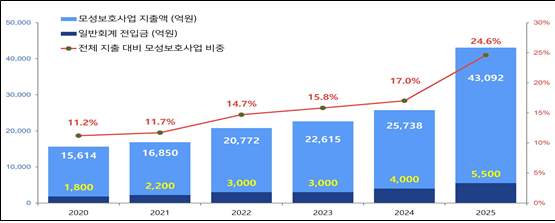
On the 24th, the Korea Employers Federation released a report titled ‘Problems and Challenges in the Funding Structure of the Maternity Protection System.’
KEF said that 75.1% of the increase in spending from the Employment Insurance Fund’s unemployment-benefit account last year stemmed from a sharp rise in spending on maternity-protection programs, including childcare leave benefits. It said the funding structure, under which most costs for the national population policy have been covered by premiums paid by labor and management, is the root cause of the fund’s worsening finances. In particular, it stressed that responsible measures must come first, including codifying the government’s statutory share of state funding for spending from the newly established maternity-protection account, before the government proceeds with its planned increase in employment insurance premium rates.
According to KEF, maternity-protection programs accounted for 11.2% of total spending from the unemployment-benefit account in 2020, rising to 24.6% last year. The increase in spending on maternity-protection programs last year (1.7 trillion won) amounted to 75% of the rise in total spending from the unemployment-benefit account. Of total maternity-protection spending, state funding provided through the general account covered just 12.8% (550 billion won), while the remaining roughly 87% was made up through premiums paid by labor and management, KEF said.
KEF said the government’s planned measures to stabilize the fund’s finances have limitations in all four areas: the principles, scale, sequence and structure of cost-sharing. On the principle, it said that because support for workers’ childbirth and childcare is a national population policy that benefits society as a whole by cultivating the future workforce and taxpayers, its costs should also be shared through general taxation. However, the policy is less effective because the Employment Insurance Act does not specify the state’s share of the costs.
On the scale of the costs, KEF said that labor and management are expected to bear an additional roughly 1.6 trillion won a year as a result of the premium-rate increase in 2027 (from 1.8% to 2.0%). By contrast, the increase in transfers from the general account over the same period would be only 300 billion won (from 600 billion to 900 billion won), leaving the burden on labor and management five times the increase in state funding.
On the sequence, KEF expressed concern that while a premium-rate increase can be finalized solely through a revision to an enforcement decree, state funding depends on the annual budget process. Raising premium rates first without a legal guarantee could push the expansion of the government’s fiscal responsibility to the back burner, it said. On the structure, KEF criticized the government’s plan to transfer maternity leave benefits to an account funded entirely by employers’ premiums, saying employers would then have to cover benefits for periods that are not legally their responsibility, merely shifting who bears the cost.
Examples from abroad were also cited. Germany funds the Parent Allowance, which corresponds to childcare leave benefits, through general taxation, while Sweden sets aside a portion of its social security contributions for parental insurance. Japan, which uses an employment insurance system, stipulates by law that the state covers one-eighth of the cost of childcare leave benefits, and also has a flexible provision allowing premium rates to be lowered when the fund has sufficient financial leeway, KEF said. KEF recommended moving toward a universal funding system based on general taxation, as in Germany, over the long term, while in the short term codifying the state’s share of funding in law, as in Japan, to ensure fiscal sustainability.
KEF proposed the following changes to the funding structure: specify in law the state’s share of funding for the newly established maternity-protection account (at least 20% in the first stage and at least 50% over the medium to long term); link premium-rate increases to legislation codifying the state’s share; reconsider transferring maternity leave benefits; and shift to tax-based funding over the long term. KEF also said the law should require the state’s contribution to be calculated based on actual spending, not projected revenue, with any shortfall settled the following year.
Lee Sang-cheol, head of KEF’s Employment and Social Policy Division, said, “The business community deeply agrees that the maternity protection system needs to be expanded to help overcome the low birth rate.” He added, “Maternity-protection programs, including childcare leave, are a national population policy that creates the future workforce and taxpayers, so the principle is that their costs should be shared through general taxation.”
He added, “Even if adjustments to premium rates are unavoidable because of the fund’s financial difficulties, the priority is to legislate the government’s mandatory share of funding for maternity-protection programs, gradually raising it to at least 50%.”
[email protected] Kim Dong-chan Reporter