Republic of Korea Air Force Completes Its Own 'Space Weather Forecast and Warning System,' Leaving No Radar Blind Spots Even Amid Solar Flares and Electronic Warfare
- Input
- 2026-11-24 13:28:44
- Updated
- 2026-11-24 15:12:13
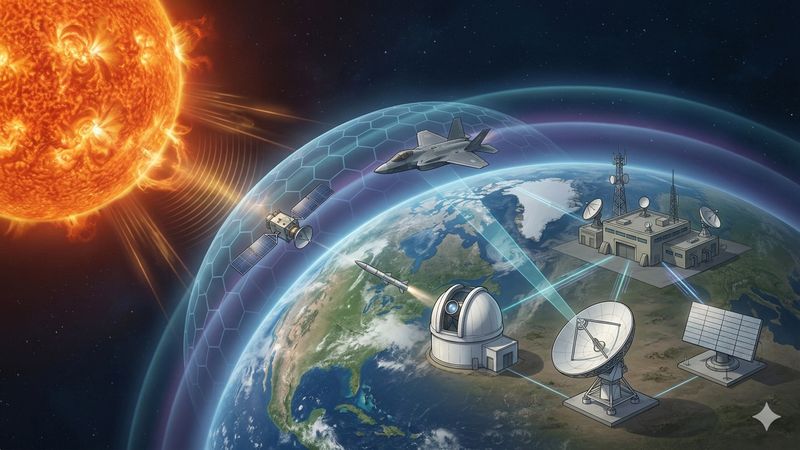
This fielding marks the completion of the ROK Air Force’s project to build a space weather forecast and warning system, which it has pursued since 2021. After first fielding the solar radio telescope, the very high frequency (VHF) ionospheric radar and the space weather information processor last December, the ROK Air Force fielded the final key piece, the solar optical telescope, this month, completing the integrated deployment of all four core components.
Space weather refers to changes in the space environment between the Sun and Earth caused by solar activity. When the ionosphere in the upper atmosphere is disturbed by sunspot eruptions and other events, radio communications with aircraft may be cut off or GPS positioning errors may surge, placing severe constraints on the operation of precision-guided weapons and satellites.
The newly established system operates a comprehensive monitoring network divided into observation and information-processing units. The solar optical telescope directly images the Sun’s surface to capture sunspot eruptions in real time; the solar radio telescope measures changes in the strength of solar radio emissions in military frequency bands; and the ionospheric radar monitors the state of the ionosphere above Earth. The Space Weather Unit under the Space Operations Wing fuses and analyzes these three sets of observation data using the space weather information processor, then predicts their effects on military communications, navigation, radar and satellite operations and relays real-time forecasts and warnings to operational units at all levels.■Why Does the Military Need Its Own System When the KMA Is Already There? “Protecting Military-Only Frequencies and Preventing Misjudgments About Electronic Warfare”Some are asking why the military built a separate system when civilian agencies such as the KMA and the Korea AeroSpace Administration already provide space weather forecasts. The key reasons are protecting military-only frequency bands, operational security (OPSEC) and identifying electronic warfare situations.
While civilian forecasts focus on protecting commercial satellites, general aviation routes and ground power grids, the military operates specially encrypted military-only frequencies, tactical data links and long-range surveillance radars to avoid enemy radio jamming. Only the military’s own observation equipment can calculate the precise level of interference affecting the specific frequency bands used by its weapons systems when solar flares disturb the ionosphere. An independent system within the military to produce and relay data is also essential to prepare for the possibility that external data networks may be cut off in wartime or a crisis, and to prevent operational airspace and timing from being exposed.
In particular, if friendly long-range early-warning radars or satellite communications are suddenly disrupted in wartime or a crisis, the system can immediately determine whether the cause is a high-power electronic warfare (jamming) attack by North Korea or a neighboring country, or a natural ionospheric disturbance caused by a solar flare, helping prevent the command from making a mistaken judgment. It also minimizes detection blind spots in missile defense radars tracking North Korean ballistic missiles by correcting in real time for changes in the ionosphere’s refractive index. The system is expected to provide a foundation for coordinating combined space operations and sharing independently collected observation data with allies, including U.S. Space Forces Korea.
The United States also independently operates the U.S. Air Force’s 2nd Space Weather Squadron, separately from the Space Weather Prediction Center under the civilian National Oceanic and Atmospheric Administration (NOAA). It provides military-specific space weather warnings in real time to the U.S. Space Force and U.S. military operational units around the world. This is because, without control over variables such as reconnaissance satellites’ orbits shifting or GPS errors increasing for precision-guided weapons as solar activity changes, precision strikes and intelligence, surveillance and reconnaissance operations—the core of modern warfare—could themselves be paralyzed.■Essential Infrastructure for Protecting Reconnaissance Satellites and the Three-Axis System; Advancing Space Operations Wing CapabilitiesMilitary observers see the completed system as an essential foundation for ensuring the survivability of the ROK military’s key assets, the South Korean Three-Axis System and its independent reconnaissance satellites under the 425 Project. Solar activity has recently intensified, and cases of satellites straying from orbit and radio interference have been reported around the world. The new system means the ROK military can now independently forecast and respond to space weather variables in the operational theater.
As space has emerged as a key domain in future warfare, the ROK Air Force has steadily expanded its surveillance and observation capabilities. In January 2022, it fielded an electro-optical satellite surveillance system to detect and track satellites and space objects over the Korean Peninsula. In January 2024, it established the military’s first dedicated space weather organization, the Space Weather Unit. It then established the Space Operations Wing in June of the same year, creating a system for unified command of space assets. With the completion of the space weather forecast and warning system, it has further filled out the Space Situational Awareness (SSA) puzzle.
Colonel Hwang Young-min, commander of the ROK Air Force Space Operations Wing, said, “As the use of satellite-based communications and navigation in military operations continues to expand, space weather information is becoming increasingly important.” He added, “We will use the space weather forecast and warning system to enhance our space situational awareness and support the successful execution of operations.”
[email protected] Lee Jong-yoon Reporter