“Leading the Way in Win-Win Technology Sharing to Resolve Inter-Floor Noise”... Samsung C&T Shares Research Findings
- Input
- 2026-11-24 10:47:40
- Updated
- 2026-11-24 10:47:40
Samsung C&T announced on the 24th that it will take part in the 2026 Fall Conference on Noise and Vibration, to be held at the Yeosu Expo Convention Center from the 25th to the 28th, and host a special corporate session. Hosted by the Korean Society for Noise and Vibration Engineering, the conference is the country’s largest academic event in the field of noise and vibration, drawing around 800 to 1,000 participants from industry, academia and research each year. Samsung C&T was the only construction company to participate.
At the special session, titled “Samsung C&T’s Floor Systems and Inter-Floor Noise Reduction,” nine papers will be presented, showcasing research findings accumulated to date and the development of key technologies. Topics include comparisons and analyses of floor impact sound through mock-up tests; an inter-floor noise prediction model using artificial intelligence (AI) data analysis; active noise-control technology that cancels out noise; and assessments of the properties of multilayer metamaterials for reducing heavy-weight impact sound. These research findings enhance practical applicability and technical maturity.
Samsung C&T views inter-floor noise-reduction technology not as an exclusive means of competition among companies, but as a technology serving the public interest by addressing a social problem, and has consistently worked to make its technologies available. In addition to sharing research data through specialized academic societies, it obtained a recognition certificate for a Grade 1 floor system jointly developed with its partner Geoway in the partner’s name, making the system freely available for use by other construction companies.
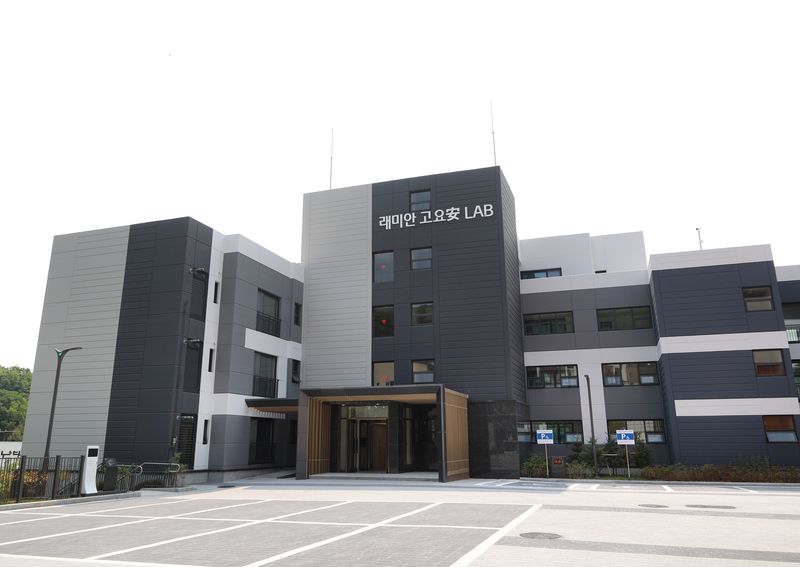
Samsung C&T is also actively fostering on-site collaboration by opening its demonstration research facility. Since February, it has shared noise-reduction technologies and verified performance with four construction companies, opening its research facility, Raemian Goyoan LAB, for mock-up testing and providing support. Since the facility opened, around 50 organizations, including partners, universities and research institutes, have visited to conduct performance verification and testing under a range of conditions.
Proactive investment in research infrastructure underpins these efforts to promote mutual growth. In December 2020, Samsung C&T became the first in the industry to establish a dedicated research team for inter-floor noise, and in 2022 it opened Raemian Goyoan LAB in Giheung-gu, Yongin-si, Gyeonggi Province. The facility was built to allow technologies to be tested under conditions matching actual residential environments. Its demonstration facility, comprising 10 housing units, incorporates four types of residential structures—wall-type, column-type, hybrid and rahmen—and floor slabs 210–300 mm thick.
Building on this work, Samsung C&T has registered 17 patents related to inter-floor noise, including a point-supported sound-insulation structure system, active noise-control technology and an inter-floor noise monitoring system. In 2024, it demonstrated its distinctive technological capabilities by achieving the highest rating, Grade 1, for both lightweight and heavy-weight impact sound in floor-structure performance testing conducted by the Korea Institute of Civil Engineering and Building Technology (KICT).
Lee Seong-jae, deputy head of Samsung C&T’s Inter-Floor Noise Research Institute, said, “We will continue to actively share Goyoan LAB’s research findings with external research institutes and at academic conferences, and work to resolve inter-floor noise through measures such as establishing technical standards and conducting joint research.”
[email protected] Jeon Min-kyung Reporter