‘Credit Finance 2.0’ Era Is Coming... ‘AI Commercialization Is Near, but Regulations Are Inadequate’
- Input
- 2026-11-24 15:19:20
- Updated
- 2026-11-24 15:19:20
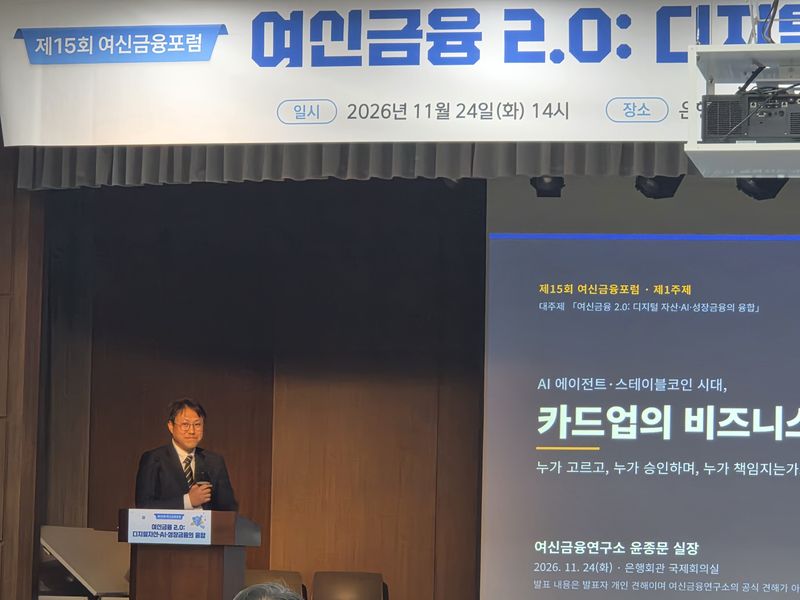
Legal frameworks fall short of expectations
Yoon Jong-mun, director of the Credit Finance Research Institute, said at the 15th Credit Finance Forum, held on the 24th at Bankers’ Hall in Jung District, Seoul, under the theme “Credit Finance 2.0: Convergence of Digital Assets, AI and Growth Finance,” that “the industry believes that legal frameworks, fraud detection systems (FDS) and readiness to use AI are inadequate compared with forecasts that AI agent payments will arrive ‘quickly and on a large scale.’”In a survey conducted last August of 71 executives and employees at card companies, 80.3% expected AI agent payments to be commercialized within five years, but 77.5% said the current legal framework was inadequate. A further 76.1% said their company’s use of AI was “at the pilot stage or less,” highlighting a wide gap between expectations and reality.
Yoon said, “The industry identified unclear accountability, rather than the technology itself, as the greatest risk,” adding that “records of delegated authority and standards for prompt redress are needed to prepare for new disputes such as ‘I never delegated that much authority.’”
Legislation in this area is also inadequate. As of last September, none of the 10 stablecoin-related bills pending in the National Assembly separately addressed cancellations and refunds for payments made to merchants. Yoon said, “In addition to rules governing issuance, we need a basis for protecting users at the payment stage and for the participation of payment intermediaries such as card companies.”
He added, “Stablecoins can be used for wallet-to-wallet transfers, but using them for payments is difficult because the goods might not arrive as expected or the other party’s consent may be required to cancel a transaction.” He noted that “card companies need to participate to serve as intermediaries.”
If AI agents become widely used, card companies are expected to provide information to the agents while taking on the roles of gatekeeper and decision-maker. Three challenges were identified at each stage of payment: designing products suited to an AI-driven selection environment before a transaction; expanding FDS and aligning delegated authority with credit limits during a transaction; and assessing records of delegation and execution after a transaction.
Yoon also identified shared industry priorities, including tokenization, joint proof-of-concept projects, guidelines and standardization, as well as proof of delegated authority, transaction controls and prompt redress.
The Credit Finance Association described “Credit Finance 2.0” as the process by which the industry responds to changes AI and blockchain are bringing to three areas: payments, funding and investment. Association Chairman Lee Dong-cheol said, “AI is changing who initiates payments and how finance is assessed, while blockchain is changing how money moves and is recorded.”
“Expanded roles for capital companies and new technology finance companies”
In the second presentation, Kangwon National University professor Shim Se-ri identified financial intermediation that eases constraints involving information, collateral and cash flow as a role for capital companies. The presentation was titled “The Digital Redesign of Industrial Finance: Finding New Growth Drivers for Capital Companies.”Shim said, “Leasing, which is easy to recover, expands companies’ borrowing capacity, while sales, equipment and transaction data help tailor financing terms to their repayment capacity and the timing of their revenue.” She added that “industrial asset finance, partnerships in manufacturing and platforms, supply chain finance, and asset recirculation are growth areas.”
On supply chain finance, she added, “Data can be used to assess residual value and secure recovery and resale channels, easing collateral constraints.”
Na Su-mi, a research fellow at the Korea SMEs and Startups Institute, gave the final presentation, titled “Revitalizing Risk Capital and Growth Finance: The Role of New Technology Finance Companies.” She said new technology finance companies “are expanding their role as key providers in the venture investment market.”
Last year, new investments by new technology finance companies totaled 6.8 trillion won, up 28.2% from the previous year. Investment per company was also higher, at 3.16 billion won, compared with 2.87 billion won for venture capital firms.
However, Na said the ratio of outstanding investments to new investments rose from an average of 2.2 times in 2015–2020 to 3.6 times last year, signaling delays in exits. She proposed that “there needs to be a way for new technology business investment associations to participate in exit funding being raised in Korea, including secondary and mergers and acquisitions (M&A) funds.”
Policy priorities to support this include expanding scale-up finance, strengthening the role of strategic investment instruments, expanding the role of secondary-market buyers, and broadening the scope of investment.
Lee urged financial authorities and the National Assembly to “review the current system and regulations so that a clear legal basis is established for card companies to handle wallets, payments and settlements in the new environment, and so that capital companies can expand leasing of advanced equipment and new technology finance companies can increase investment in advanced technology firms.”
[email protected] Kim Tae-il Reporter