"Thought It Was the Economy, but Was It AI?..." 73% of Job Seekers Say, "Finding a Job Will Be Harder Next Year"
- Input
- 2026-11-24 10:33:08
- Updated
- 2026-11-24 10:33:08
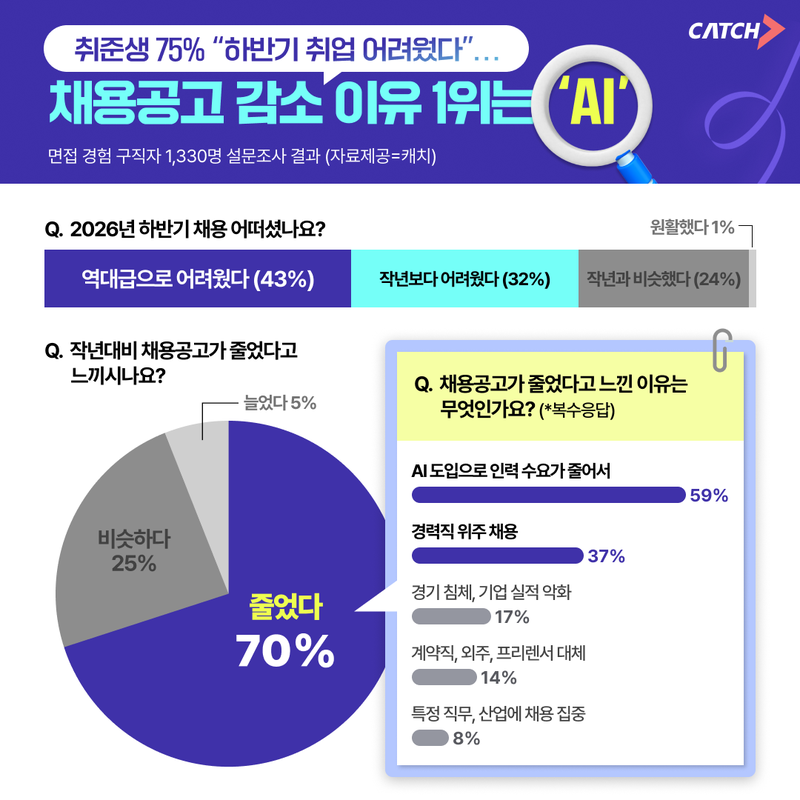
On the 24th, according to a survey on “Employment Sentiment for the Second Half of 2026” conducted by CATCH among 1,330 job seekers, 75% of the 770 respondents who had actually applied for jobs in the second half said it had been difficult to find a job.
The most common response, at 43%, was that it had been “unprecedentedly difficult,” while 32% said it had been more difficult than last year. Another 24% said it was about the same as last year, and just 1% said it had been exceptionally smooth.
Seven in 10 applicants in the second half felt there were fewer job postings than last year.
The most common reason cited for the decline in job postings (multiple responses allowed), at 59%, was that “companies’ labor needs themselves have fallen because of AI adoption.” This was followed by fewer entry-level postings as hiring focused on experienced workers (37%), the economic downturn and weaker corporate performance (17%), and replacement by outsourcing, freelance work, or contract positions (14%).
In particular, far more job seekers cited AI as a reason for the decline in job postings. In the first-half survey, 23% pointed to AI adoption as a cause, compared with 59% in the second half, a rise of 36 percentage points. By contrast, the share citing the economic downturn fell 21 percentage points over the same period, from 38% to 17%. The findings suggest that job seekers’ view of the contracting hiring market is shifting from economic conditions to changes in industrial and employment structures driven by AI.
Job seekers also felt considerable pressure from AI-related changes in the hiring process. Asked what they found most difficult, the largest share, 41%, said “adapting to new hiring methods, such as AI interviews.” This was followed by high hiring standards (38%), psychological pressure and burnout (23%), and the burden of preparing their credentials (20%). The analysis suggests that as AI changes not only companies’ hiring needs but also their assessment methods, it is increasing the burden on job seekers as they prepare.
There are also widespread concerns that the current difficulties finding work will persist into the first half of next year. Of all 1,330 respondents, 73% expect the hiring market in the first half of next year to be tougher than it is now. Among them, 38% said it would become “much more difficult,” and 35% said “somewhat more difficult.” Just 22% expected conditions to remain about the same, while only 5% expected them to improve. With 71% in the first-half survey also predicting a worsening hiring market, pessimism has persisted for six months.
Kim Jeong-hyeon, head of CATCH, said, “As more people recognize that the spread of AI is changing companies’ labor needs and hiring processes, job seekers also seem to be struggling to decide how to prepare.” He added, “Companies should clearly explain the assessment criteria and hiring procedures for each role, while job seekers need to prepare by looking into the skills required for roles and the hiring methods that are changing with AI adoption.”
[email protected] Lee Ju-mi Reporter