Markets Cheer Jensen Huang’s Return ... “Prepare for Rising Volatility Amid the Rebound”
- Input
- 2026-11-24 09:55:17
- Updated
- 2026-11-24 09:55:51
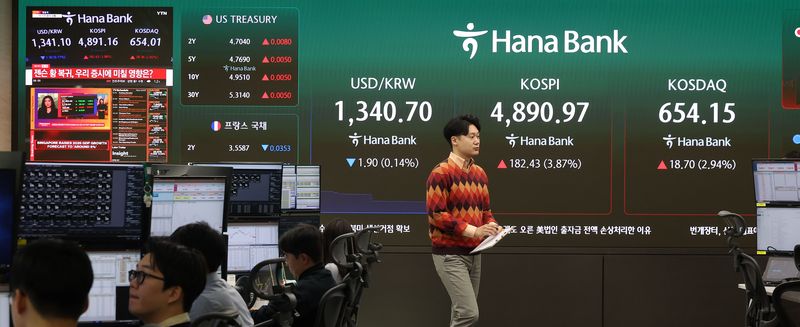
[Financial News] South Korea’s stock market has staged a sharp rebound on news that NVIDIA CEO Jensen Huang is returning, but analysts have advised investors to prepare for increased volatility.
Han Ji-young, an analyst at KIWOOM Securities, interpreted Huang’s return on the 24th as having “appeared to ease investor anxiety over the continuity of the artificial intelligence (AI) ecosystem, going beyond simply mitigating owner-related risk.”
All three major New York stock indexes closed higher the previous day. The S&P 500 rose 4.73%, the Dow Jones Industrial Average (DJIA) gained 3.01%, and the NASDAQ Composite Index climbed 6.51%.
NVIDIA surged 31.48% on Huang’s return, while AI-related stocks including Micron (19.04%), CoreWeave (22.32%) and Oracle (12.34%) also jumped. The PHLX Semiconductor Sector Index (SOX) rose 14.03%.
South Korea’s stock market is also surging. As of 9:50 a.m. on the 24th, the KOSPI was trading at 4,989.80, up 281.26 points (5.97%) from the previous trading day.
The analyst forecast that “a surge in U.S. AI stocks following Huang’s return, along with news that KOSPI 200 night futures surged in the 7% range, will revive investor sentiment, particularly toward AI infrastructure stocks such as semiconductors, power equipment and MLCCs, and support a rally.”
She added that “AI and semiconductor stocks have already priced in the worst-case scenario, on a scale comparable to the financial crisis or the collapse of the dot-com bubble,” and that “at this point, rather than focusing on the risk of further sharp declines, it is appropriate to remain open to the possibility that share-price resilience will improve while monitoring related issues.”
However, she noted that investors should be wary of increased volatility, as factors of uncertainty remain.
Han said, “Independent and government investigations into Huang are scheduled to continue through early next month, and there may be some noise during that process.” She added, “It is difficult to say that the underlying concerns that have driven the stock market’s correction since last month—including uncertainty over AI companies’ investment profitability and free cash flow (FCF), uncertainty over the Democrats’ data-center regulations, and concerns about a memory downcycle—have been fully resolved.”
She added, “With market concerns not yet fully dissipated, investors need to prepare for the possibility of greater volatility going forward.”
Huang’s return is expected to act as a short-term positive catalyst, the analyst explained, adding that key events include macroeconomic developments such as the U.S. October personal consumption expenditures (PCE) inflation data and remarks by Federal Reserve (Fed) officials due this week, as well as earnings events for AI stocks such as Dell.
She also forecast that “whether the market stabilization fund moves to the stage of actually injecting funds once its specific criteria are finalized, and whether easing limits on share buybacks prompts companies to materially increase repurchases, will be short-term factors determining the stock market’s recovery momentum.”
[email protected] Seo Min-ji Reporter