After Lee Calls for an M&A Push, Ruling Party Keeps 100% Mandatory Tender Offers on the Table and Urges Talks With Opposition
- Input
- 2026-11-24 09:46:19
- Updated
- 2026-11-24 09:46:19
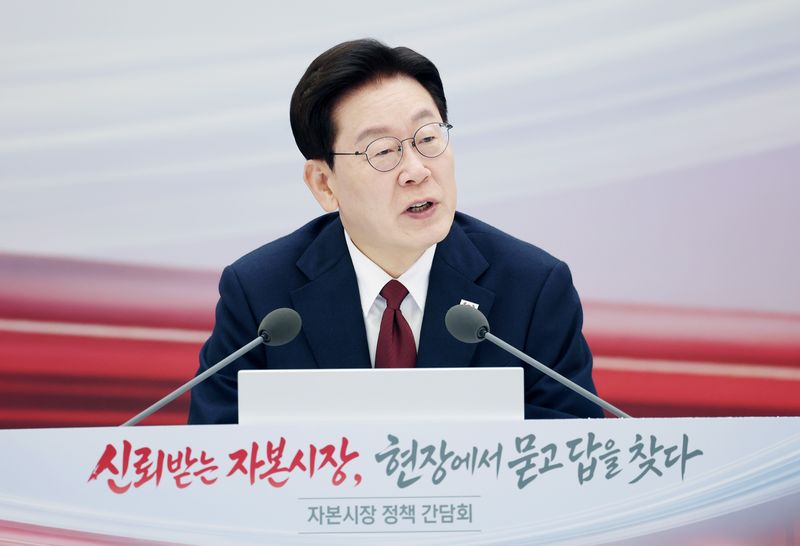
Speaking to reporters after a closed-door meeting at the National Assembly on the 24th, Oh Ki-hyung, chair of the Democratic Party's K-Capital Market Special Committee, said of the mandatory tender offer system, “Will it be 100%, 50% with pro rata allocation, or 75% like the Japanese model, but with flexibility? Those are the issues being finalized at the last minute,” adding, “We are keeping all options open.”
The mandatory tender offer system ensures that ordinary shareholders also have an opportunity to share in the control premium during an acquisition of corporate control. The ruling and opposition parties had previously agreed on an amendment to the Capital Markets Act requiring an acquirer to secure at least '50%+1 share' of a company's total issued shares. However, the bill's consideration at the plenary session was put on hold after 18 domestic and foreign asset managers and others objected, saying that if the controlling shareholder's stake were purchased first, ordinary shareholders' opportunity to sell would be limited.
At a capital markets policy meeting held at the Korea Exchange on the 13th, Lee emphasized the promotion of M&A and called for discussions on the mandatory tender offer system not to be “delayed too much.” This also aligns with his plan to accelerate efforts to improve the fundamentals of the capital market, including enhancing corporate value and revitalizing KOSDAQ, in order to build a sustainable stock market that does not depend on booms in artificial intelligence (AI) and semiconductors.
However, the ruling party has yet to find a compromise between protecting minority shareholders and concerns that M&A activity could be dampened. The Democratic Party also failed to reach a conclusion on the purchase ratio and method at its general meeting of lawmakers on the 10th.
Oh said, “We cannot simply declare invalid what lawmakers from both parties agreed on and passed in the National Policy Committee,” but added, “It is right to make adjustments if necessary.” He continued, “It would be good if the People Power Party stated its position on mandatory tender offers,” and stressed, “We will negotiate flexibly, reflect the concerns of market participants, and work together to find alternatives.”
Democratic Party lawmaker Kim Nam-geun, a member of the special committee, also left open the possibility of renewed discussions if the People Power Party clarifies its position. In response to concerns that a 100% tender offer could dampen M&A, he countered, “Ordinary shareholders are not required to sell all their shares,” adding, “In reality, adopting a 100% requirement would not significantly impede M&A.”
Meanwhile, the special committee also discussed measures to prevent unfair trading, including front-running by “finfluencers,” or financial investment influencers, as part of efforts to address information asymmetry in the KOSDAQ market. It decided to ask the Financial Supervisory Service (FSS) to conduct active inspections and to accelerate follow-up legislation aimed at enhancing the value of undervalued companies.
To that end, committee chair Oh said he hoped a bill related to “Bear Hug”—a system requiring a board to disclose to shareholders its review of an acquisition proposal and the grounds for its decision—would be passed within the year. The committee also plans to reach a decision on an amendment to the Inheritance and Gift Tax Act this month.
[email protected] Jiwon Song Reporter