KICPA Chair Choi Woon-yul: "Companies Must Explain Changes in Operating Profit to the Market Under the New IFRS 18 Standard" [18th International Accounting Forum]
- Input
- 2026-11-24 10:05:19
- Updated
- 2026-11-24 10:05:19
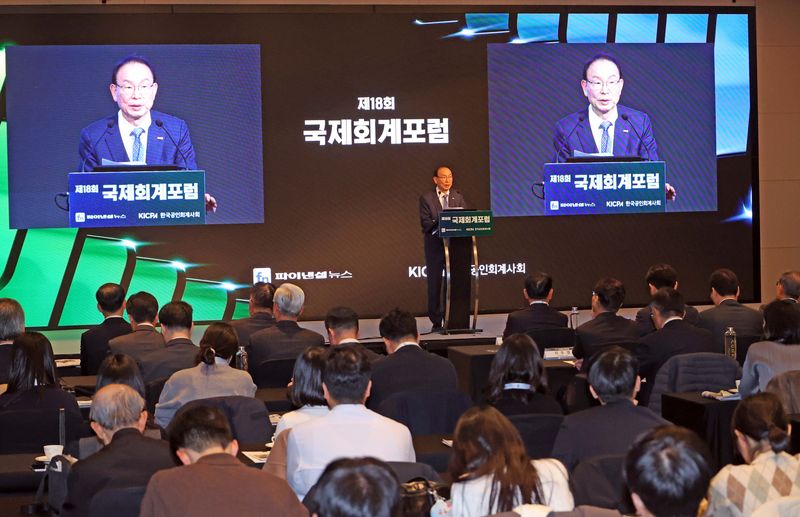
[Financial News] Choi Woon-yul, chairman of the Korean Institute of Certified Public Accountants (KICPA), emphasized companies’ practical preparations and communication with the market ahead of the implementation of International Financial Reporting Standard (IFRS 18).
Because the new accounting standard will change how operating profit is presented, companies need to accurately assess the impact of the changes and explain them fully to investors.
In his welcome address at the 18th International Accounting Forum, jointly hosted by Financial News and KICPA on the 24th, Chairman Choi said, "With IFRS 18 set to take effect next January, it is now time to wrap up preparations and begin applying it in practice." He added, "The most practical question being asked on the ground right now is, ‘Why is operating profit different when the results are the same?’"
He outlined three key challenges facing companies: applying the new profit-and-loss classification system, ensuring consistency with international interpretations, and communicating with the market.
He first stressed the need to clarify each company’s accounting judgment criteria in line with the new profit-and-loss classification system. Key issues include what should be considered a primary business activity, whether an asset generates income largely independently of other resources, and which category should include foreign exchange differences and gains and losses on derivatives.
Chairman Choi said, "Companies need to thoroughly review their actual business activities and risk management practices and clearly document the basis for their judgments." He added, "It is also important to reflect the results in accounting policies and internal controls and apply them consistently."
He also identified consistency with international accounting interpretations as a challenge. As the IFRS Interpretations Committee continues to discuss key implementation issues, including the classification of income and expenses into categories, management-defined performance measures (MPMs), and disclosures of expenses by nature, domestic companies also need to closely follow those discussions.
He urged companies to closely monitor finalized agenda decisions and ongoing discussions so that Korean companies can also apply the standard consistently with international practice.
He highlighted communication with investors and the market as a particularly important task. In the first year of the transition to IFRS 18, companies will need to distinguish between changes in operating profit resulting from the accounting standard change and changes in actual business performance.
Chairman Choi said, "To help investors correctly understand changes in operating profit, companies need to distinguish between changes in actual business performance and the impact of changes in presentation." He added, "Fully communicating the revised composition of operating profit and the effects of the transition is the way to build the market’s understanding and trust."
He also expressed the KICPA’s commitment to provide support. Chairman Choi said, "We will actively support the smooth adoption of IFRS 18 in practice through member education and assistance with its practical application."
He added, "For a new corporate report card to serve its purpose, preparers must fully set out the basis for their judgments, and users must be able to accurately understand what the changed figures mean." He continued, "I hope today’s discussions will turn companies’ preparations into concrete action and help IFRS 18 take root smoothly from its first year of implementation."
[email protected] Kang Jung-mo Reporter