A Small Incision Instead of a Split Breastbone... Faster Recovery for Heart Surgery Patients [Health Check]
- Input
- 2026-11-24 09:03:14
- Updated
- 2026-11-24 09:03:14
[Financial News] Minimally invasive surgery, which treats multiple heart valves at once through an incision of just 5–7 cm in the right chest without splitting the breastbone, was found to lead to faster recovery than conventional surgery. Time spent in the intensive care unit was cut in half, and the hospital stay was also four days shorter.
A research team led by Professor Je Hyeong-gon of the Department of Thoracic and Cardiovascular Surgery at Seoul National University Bundang Hospital (with resident physician Hwang Chan-sop as first author) said it had published a study comparing the outcomes of minimally invasive surgery and median sternotomy for multiple-valve surgery that included the aortic valve.
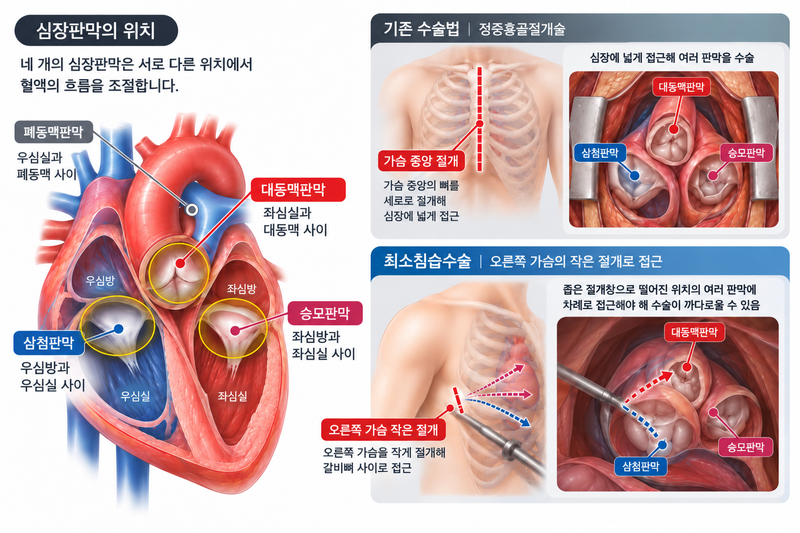
The heart has four valves that open and close to ensure blood flows in one direction. The aortic valve, the focus of this study, is at the exit through which blood leaves the heart for the rest of the body. The mitral and tricuspid valves are located between the atria and ventricles on the left and right sides of the heart, respectively. If aging or disease prevents a valve from functioning properly, it must be repaired or replaced with an artificial valve. Problems affecting two or more valves at the same time are called “multivalvular disease.”
Until now, multiple-valve surgery has mainly been performed through a median sternotomy, in which the breastbone is split down the middle of the chest. This was considered a reliable approach because surgery on valves in different locations at the same time requires a wide view of the heart. However, cutting the breastbone can cause significant pain and make recovery more difficult, and it also carries a risk of complications such as infection.
In minimally invasive surgery, an incision of about 5–7 cm is made in the right chest, and the surgeon reaches the valves between the ribs to treat them. Because it does not involve splitting the breastbone, it can reduce the physical burden and is already widely used for single-valve surgery. Multiple-valve surgery, however, is more challenging because the surgeon must reach valves in several locations through a narrow field of view.
The research team analyzed 203 patients who underwent multiple-valve surgery that included the aortic valve at Seoul National University Bundang Hospital and Yangsan Pusan National University Hospital between May 2015 and May 2025. Of these, 30 underwent minimally invasive surgery and 173 underwent median sternotomy.
Because minimally invasive surgery is performed in a confined space, there were concerns that it might need to be converted to a median sternotomy during the operation or that it might take longer. In valve surgery, the aorta is clamped to stop the heart, and a heart-lung machine takes over the heart and lung functions, so the longer the operation, the greater the burden on the patient. The analysis found that all 30 patients who underwent minimally invasive surgery completed the procedure without conversion to a median sternotomy. Aortic cross-clamp time and time on cardiopulmonary bypass also did not differ significantly from those in the median sternotomy group.
Recovery was faster in the minimally invasive surgery group. Patients received fewer transfusions and were taken off ventilators sooner. The median time in the intensive care unit was 23 hours, about half the 46 hours in the median sternotomy group, and the hospital stay was five days—four days shorter than the nine days in the median sternotomy group.
There was also no difference in long-term outcomes. After about three years of follow-up for the minimally invasive surgery group and about five years for the median sternotomy group, there was no significant difference in survival rates between the two groups. The rates of “valvular regurgitation,” in which blood flows backward as valve function deteriorates, were also similar.
Professor Je said, “This study shows that minimally invasive surgery is an option that can be seriously considered for multiple-valve surgery as well. The most important thing is to treat each valve accurately, so the surgical method best suited to each patient should be selected based on the test results.” He added, “Applying minimally invasive surgery to suitable patients could reduce postoperative pain and the burden of recovery.”
The study was published in the international journal Journal of Thoracic Disease.
[email protected] Jung Myung-jin, medical correspondent Reporter