Middle East Smartphone Shipments Plunge 29%... Samsung Cements Its Lead With 45% Share
- Input
- 2026-11-24 08:53:45
- Updated
- 2026-11-24 08:53:45
Samsung's share rises 11 percentage points... Galaxy A series performs well
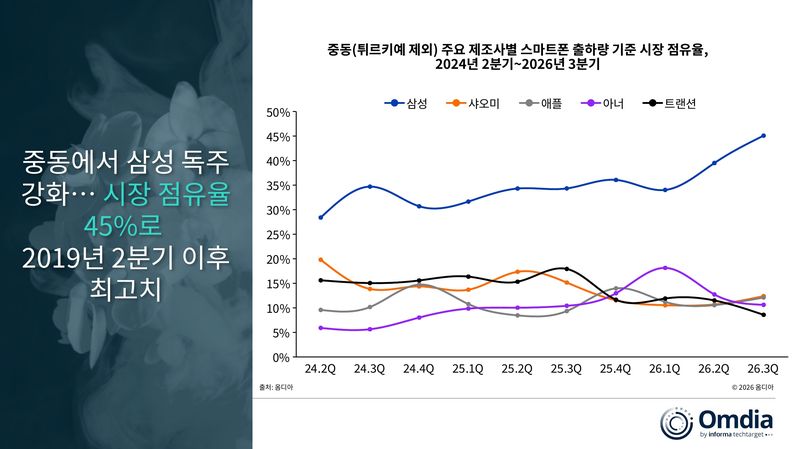
According to market research firm Omdia on the 24th, smartphone shipments in the Middle East (excluding Türkiye) totaled 10.7 million units in the third quarter of this year, down 29% from the same period a year earlier. The main reasons cited were reduced supplies of entry-level smartphones due to rising component costs and weak retail demand.Samsung Electronics Co., Ltd. maintained its lead in the Middle East smartphone market with a 45% share. That was up 11 percentage points from 34% in the same period last year.
Solid demand for the Galaxy A17 and Galaxy A07 4G supported the increase in market share. A stable supply of components and a smartphone lineup covering a wide range of price points also proved to be competitive advantages. The analysis is that the company minimized its shipment decline by maintaining a broad range of choices even as the cost burden on consumers grew.
Xiaomi regained second place, led by the Redmi 17 4G and Redmi A7 Pro 4G. However, it continues to pursue a strategy of reducing the share of entry-level smartphones and focusing on more profitable models and markets.
Apple's market share rose to 12% despite a decline in shipments. Demand for premium smartphones and its distribution network supported its share, but the volume supplied to distribution channels was lower than in the same period a year earlier, as the base-model iPhone 18 was absent from the launch lineup.
HONOR recorded its first double-digit decline in shipments after three consecutive years of growth. Transsion posted the steepest decline among the top five manufacturers. Its business model, which has focused especially on low-cost smartphones, was heavily affected by rising component costs.
Entry-level shipments down 56%... Average selling price hits a record
The contraction in the Middle East smartphone market was most pronounced in the low-cost segment. In the third quarter of this year, shipments of smartphones priced below $200 fell 56% year on year, while shipments in the $400–$599 range rose 65%. As a result, the average selling price (ASP) of smartphones in the Middle East reached a record $511.However, the analysis is that the higher average selling price does not mean consumers have become more inclined to buy premium smartphones. A major factor is that, as rising component costs eroded the profitability of low-cost smartphones, manufacturers cut supplies of entry-level models and focused on more profitable ones.
Manish Prabhinkumar, a senior analyst at Omdia, explained, "Prices in the Middle East smartphone market are rising overall, but that does not necessarily mean consumers are shifting their preferences toward premium smartphones." He added, "With fewer affordable options available, price-sensitive consumers are delaying when they replace their phones."
By country, the decline was most pronounced in Iraq. Smartphone shipments there plunged 58% year on year, reaching their lowest quarterly level since the first quarter of 2023. The decline reflected the combined effects of a weaker currency, political and economic instability, and rising smartphone prices.
Shipments in Saudi Arabia and the United Arab Emirates (UAE) also fell 29% and 12%, respectively. The market contraction continued amid the summer holiday off-season and geopolitical uncertainty, as well as distributors' cautious approach to building inventory.
The weakness in the Middle East smartphone market is expected to continue next year. Omdia forecasts that smartphone shipments in the Middle East will continue to decline at a single-digit rate in 2027.
Senior analyst Prabhinkumar said, "Geopolitical uncertainty and rising component costs have made consumers more cautious about buying smartphones." He added, "Along with brand preferences, installment terms and trade-in values are having an increasingly significant influence on when consumers replace their smartphones." He continued, "In the long term, manufacturers are expected to prioritize securing sustainable profits and streamlining operating and marketing costs, while strengthening support for distribution channels and partnerships."
[email protected] Yoon Hong-jip Reporter