Plan to Block Even Original Servers Hosting Illegal Webtoon Images ... Strengthen K-Culture IP Protection
- Input
- 2026-11-24 08:14:37
- Updated
- 2026-11-24 08:14:37
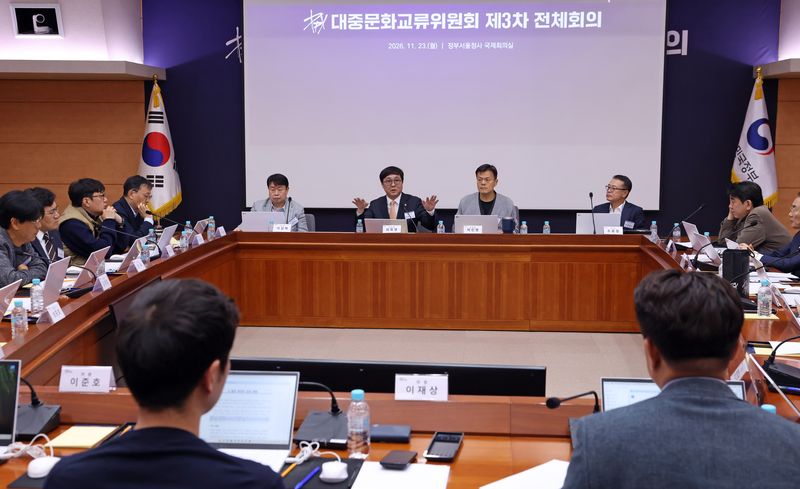
According to the Presidential Committee on Popular Culture Exchange on the 24th, the committee held its third plenary meeting at Government Complex Seoul on the 23rd and discussed “Directions for Promoting the Protection of K-Culture Intellectual Property Rights.” Co-chair Choi Hwi-young, Minister of Culture, Sports and Tourism, and co-chair Park Jin-young, executive producer at JYP Entertainment, attended, among others. The committee reviewed initiatives that government ministries had been pursuing to address the illegal distribution of content and the sale of counterfeit goods.
An investigation by the Korea Copyright Protection Agency into overseas sites distributing content illegally found that posts featuring Hallyu content rose by about 41%, from approximately 349.56 million in 2023 to approximately 493.55 million last year. Webtoons accounted for 66.5% of last year’s posts, while video content, including films and television programs, made up 33.5%.
On May 11, the Ministry of Culture, Sports and Tourism ordered emergency blocking for the first time, targeting 34 sites that infringed copyrights. After cases of circumvention emerged despite the blocking, it discussed supplementary measures with experts later that month. To prevent further distribution through replacement sites, the government plans to include the transmission routes of illegal webtoon images among the targets for blocking. The agenda also included proposals to block payments and advertising on illegal sites and ask major search platforms to limit the visibility of search results.
Of the 86,564 counterfeit goods related to K-Culture seized during customs clearance in South Korea last year, cosmetics were the most numerous, at 41,903. The Korea Customs Service, the Ministry of Intellectual Property, and the Ministry of Food and Drug Safety plan to share information on the distribution of counterfeit cosmetics and cooperate on investigations. The Korea Customs Service is also pursuing joint crackdowns with customs authorities in Thailand and Cambodia on goods that infringe intellectual property rights.
The government is considering expanding eligibility for the “Overseas Copyright Voucher” program from individual companies to include joint response consultative bodies. It also plans to step up monitoring of overseas trademark squatting and support for companies, and to introduce a government certification system for K-Brands using national certification marks and genuine-product verification technology.
Chair Choi said, “We will strengthen the whole-of-government framework for protecting intellectual property rights to ensure fair compensation for the efforts of creators and companies.” Chair Park also stressed that the value of creators’ efforts, built up over many years, must be protected.
On the 1st, the committee appointed Gu Chang-geun, CEO of Goodai Global, from the lifestyle sector, and Jang Sang-ik, head of Korea Growth Investment Corporation (K-Growth), from the investment sector, as private-sector members.
[email protected] Jang In-seo Reporter